Program
Hans Krása: Brundibár, 25 min
30-minute break
Ernst Bloch: In Memoriam, 5 min
Georg Riedel: Schloft Ale, 5 min.
Thread: Öfn veg shteyt a boym, arr Benjamin Staern, 5 min
Aaron Copland: Appalachian Spring, 25 min
More about the concert
The Mini-Opera *Brundibár*
During this concert, before intermission, we will hear Hans Krása’s mini-opera Brundibár (Czech for Bumblebee). Brundibár was written for children in 1938 in Prague. The plot is as simple as it is heartwarming. The circumstances, however, are the darkest imaginable. The opera was first staged in 1942 at a Jewish orphanage in Prague before both the composer and several of the child actors were deported to the Theresienstadt concentration camp. After two months of rehearsals there—constantly interrupted as the participating children were taken to other concentration camps and replaced by new arrivals—the premiere took place in September 1943. Brundibár – in Theresienstadt. The performance was staged 55 times, and when the camp was to be showcased as a “model ghetto” for Red Cross personnel in the spring of 1944, the Nazis also produced a propaganda film featuring the opera. The film can still be viewed on YouTube today; The Führer Has Given the Jews a Town.
On October 16, 1944, Krása is deported to Auschwitz-Birkenau. He is gassed to death two days later.
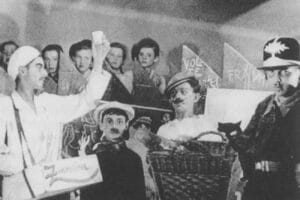
Photo from the performance 1942–43.
In Memoriam and Appalachian Spring
Act 2 continues with music by Ernst Bloch. Ernst Bloch (1880–1959) was a Swiss-Jewish composer, a citizen of the United States since 1924. As a composer, Bloch sought to create a national Jewish art music. In doing so, he has been more associated with Jewish psyche and character than with folk music. He has a rhapsodic free musical language. In 1952 he composed the piece In Memoriam , which he dedicated to the pianist Ada Clement, who died the same year.
The evening concludes with *Appalachian Spring*, a ballet by Aaron Copland. Copland was born in 1900 in Brooklyn, New York, to Jewish immigrants from Lithuania. The work was composed in 1943–44 for the American dancer Martha Graham and earned Copland the Pulitzer Prize in 1945 for best stage work of the season. The ballet depicts a pioneer community in the mountains. A young man gets married and settles down, and the pioneers come to offer their congratulations and bless the house. This takes place on a spring day in the early 1900s. The music is largely based on Native American and European folk music, dance melodies, and hymns, and consists of eight movements played in sequence. The seventh movement consists of variations on a melody that Copland drew from the Shakers, a religious sect.