More about the concert
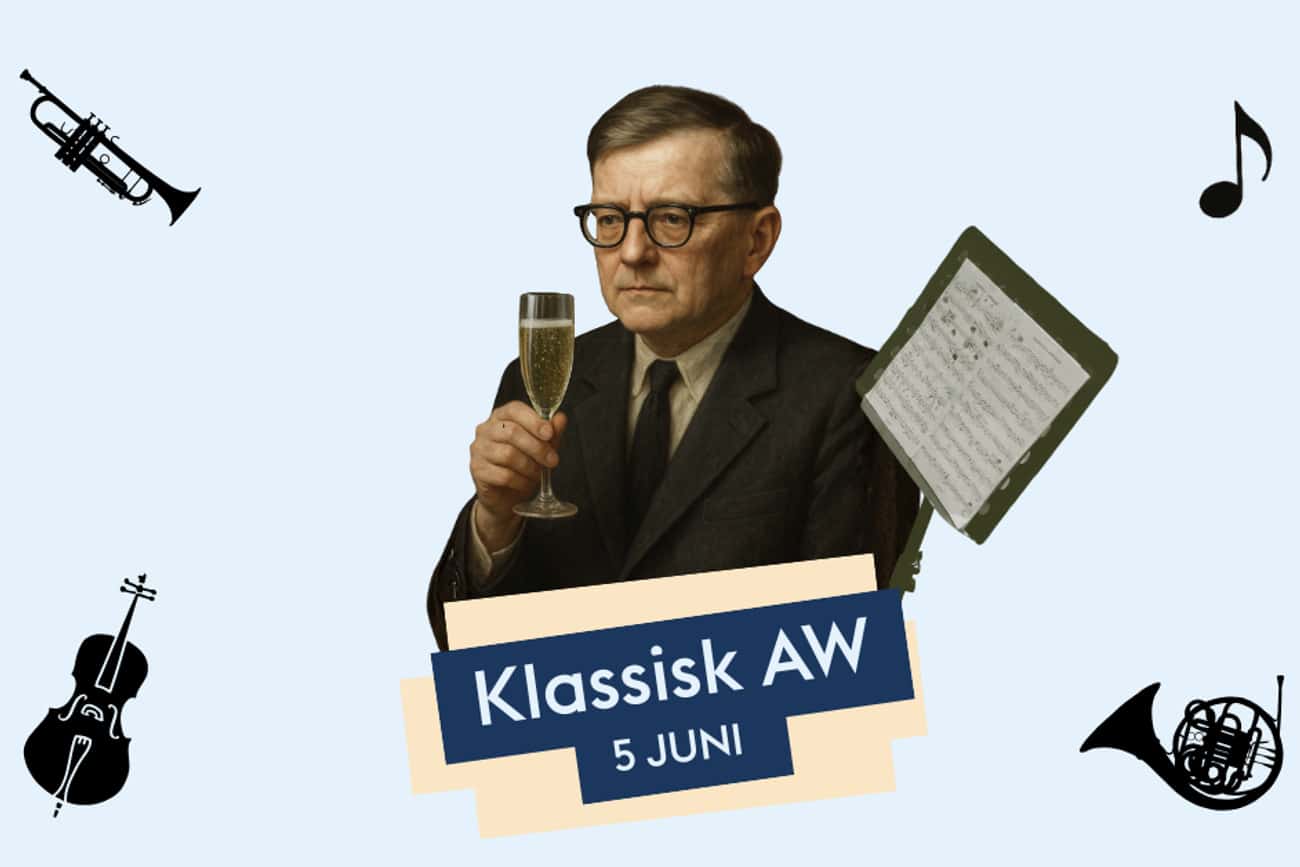
Tonight’s classical piece is Shostakovich’s Ninth Symphony, a short but hauntingly well-written masterpiece composed toward the end of the war in 1945.
To some extent, it is indeed a “party symphony.” It is said that, from the outset, Shostakovich planned something grand and magnificent to celebrate the Soviet Union’s victory over the Nazis. Speaking to his students, he spoke enthusiastically about a massive orchestra with an accompanying choir in the style of Beethoven. But during the spring and summer of 1945, when he finally set to work, he seems to have abandoned this vision—if it ever existed at all.
The Ninth Symphony is light-hearted, playful, but not jubilant, not grandiose. Anyone who has listened to Shostakovich’s brilliantly intelligent and sober music knows that pomposity has never been his style. There is therefore reason to believe that he was teasing his students. “The musicians will enjoy playing it, and the critics will tear it apart,” he is said to have remarked later. That’s not quite how it turned out; many critics appreciated his technically masterful yet brief Ninth Symphony. The premiere in St. Petersburg was broadcast live on the radio, and the work was well received. A few years later, in 1948, when Stalin’s reign of terror truly took hold, it ended up on a list of banned works.
The Ninth Symphony is, first and foremost, short—just 27 minutes—and distinctly chamber-like. As always, spending time with Shostakovich is a special treat; regardless of the form, his music never ceases to surprise. The only thing you can count on is that you never know what to expect.
About Dmitri Shostakovich (1906–1975)
Dmitri Shostakovich lived in an era when music was not only art but also politics. At times, he was both a star in the Soviet Union and a figurehead for communism in the West. The next moment, he was out in the cold because Stalin had turned against him, and he faced an imminent risk of being deported to the Gulag camps or even executed. In such a society, it was not easy to be an artist and composer.
The regime’s scathing criticism of the 1936 opera *Lady Macbeth of Mtsensk* marked a turning point in Shostakovich’s life. Having once been hailed as a musical prodigy, his star fell, and no one dared to have anything to do with him.
That same year, Stalin had launched “the Great Terror,” in which a wave of arrests, mass deportations, and purges between 1936 and 1938 resulted in approximately one million executions and many more lives destroyed in the Gulag camps. By targeting Shostakovich and his most successful works, the regime made it clear that no artist was untouchable.
In 1937, Shostakovich responded to the criticism with his Fifth Symphony, which can only be seen as a musical apology to the Communist Party. He himself called it “a Soviet artist’s response to justified criticism.” Now Shostakovich could be used as a political instrument to promote the culture of the Soviet Union—both within and outside the country.
During Nazi Germany’s siege of Leningrad in 1941, Shostakovich enlisted in Leningrad’s People’s Defense Forces and served as a firefighter. Photos of the world-famous composer dressed as a firefighter atop a building spread around the world. On July 20, 1942, Fireman Shostakovich even appeared on the cover of *Time* magazine under the headline “Fireman Shostakovich.”
During the siege, he composed his most famous work—the 7th Symphony, better known as the Leningrad Symphony. The work premiered in Leningrad on March 2, 1942, while the city was still under German siege. The concert was broadcast live on the radio to listeners in the Soviet Union, the United States, and the United Kingdom. “At this point, it is almost unpatriotic not to like Shostakovich’s Symphony No. 7. The work has become a symbol of Russia’s heroic resistance,” wrote the American magazine Life in 1943.
If Shostakovich and other artists in the Soviet Union had believed they would gain greater artistic freedom after the end of the war in 1945, they were sorely disappointed. On the contrary, Stalin tightened his grip on the arts when, in 1948, he gave Commissar Andrei Zhdanov responsibility for the country’s cultural policy. And even though Shostakovich had achieved the status of a national hero after the Leningrad Symphony, he still could not escape criticism.
His subsequent 8th and 9th symphonies were more formalistic and experimental than the acclaimed 7th Symphony and therefore drew the wrath of Culture Commissar Zhdanov. Zhdanov argued that the works were characterized by “unhealthy individualism.” In a public statement, Shostakovich assured the Soviet regime that he would follow the party line in the future.
In the wake of Stalin’s death, Shostakovich composed his 10th Symphony. The work has been interpreted as a commentary on Stalin’s reign of terror and its millions of victims. The brutal second movement has been interpreted by many as a portrait of Stalin, the mass murderer.
Outwardly, Shostakovich remained the regime’s useful genius, but at times he showed courage and published complex and abstract music that fell outside the party line. A good example is the music he wrote in 1961 to Yevgeny Yevtushenko’s poem “Babi Yar,” about the German massacre of 33,771 Jews in Kyiv in 1941. In the Soviet Union, it was illegal to honor Jews, who in official terminology could only be referred to as “Soviet citizens.” The fact that Shostakovich set the poem to music anyway led to harsh criticism from the regime.
Shostakovich didn’t just write music. During his lifetime, he managed to get married three times, became a father, and cheered on his local soccer team. He even wrote a ballet about the trials and tribulations of a Soviet soccer team on tour in the evil West. The final years of Shostakovich’s life were plagued by illness, and in 1972, the great artist was diagnosed with lung cancer. Three years later, on August 9, 1975, he passed away.
Source: varldenshistoria.se