Program
Carl Maria von Weber: The Freischütz Overture, 10 min
Anna Clyne: Glasslands, for saxophone and orchestra, 25 min
I. Part I
II. Part II
III. Part III
30-minute break
Felix Mendelssohn: Symphony No. 3, 40 min
I. Andante con moto – Allegro un poco agitato
II. Vivace non troppo
III. Adagio
IV. Allegro vivacissimo – Allegro maestoso assai
More about the concert
Nature and myths take center stage in this concert—where, as usual, well-known classical pieces are blended with brand-new compositions.
The program opens with the overture to Carl Maria von Weber’s opera, the 1821 hit *Der Freischütz* ( *The Freeshooter* ). An opera about a war-weary mercenary who makes a pact with the devil: he becomes a “free shooter” endowed with seven free shots, all of which magically hit their chosen target—with the exception of the seventh shot, which the devil himself controls. The opera quickly became a hit with audiences, not least because of its implicit anti-war theme. After the Napoleonic Wars, Europe was war-weary, and the tragic fate of the poor mercenary struck a chord with a pacifist-minded middle class.
The overture can be likened to a colorful medley that ties together the work’s many popular and nature-inspired themes, ranging from the gentle rustling of the forest and dramatic storms to gloomy, dark wolf ravines. Its dynamic composition makes it a frequently performed concert piece. The same volatile temperament is found in the opera itself, which—with its shifts between the grandiose and the tranquil—is regarded by some critics as the first great Romantic opera.
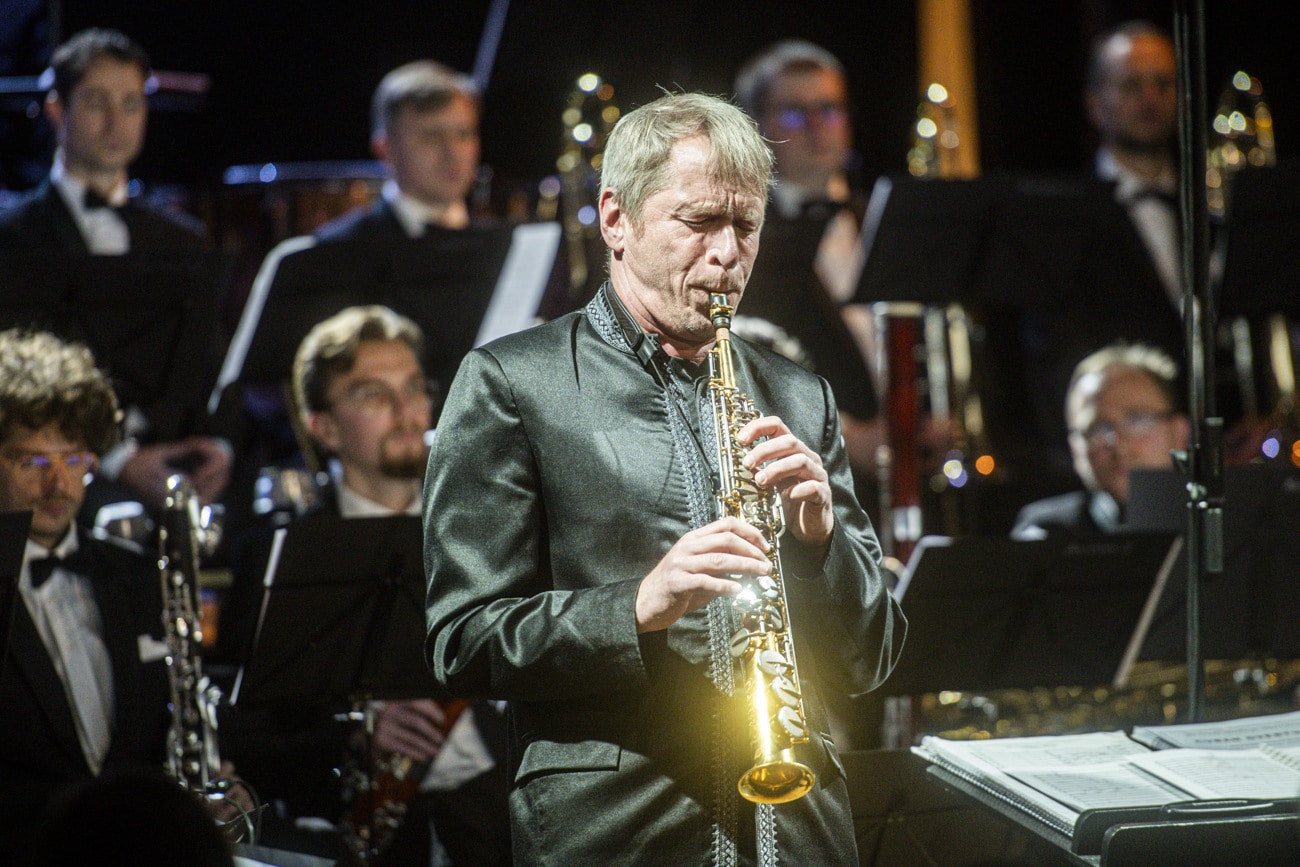
Following Webern’s overture, the concert moves on to new, romantically inspired landscapes— this time to Ireland’s windswept moors. Soprano saxophonist Anders Paulsson—on a long-awaited return visit—performs British composer Anna Clyne’s newly composed *Glasslands* for orchestra. Paulsson is among Sweden’s elite soloists and, since his debut at the venerable Carnegie Hall in the early 1990s, has toured the world with his soprano saxophone. An instrument whose higher-pitched tone, rather than a rich brass sound, brings it closer to the delicate timbral palette of the woodwinds.
According to the composer, the solo concerto is inspired by Irish mythology. The saxophone, at times whispering, at times lamenting, mimics a Banshee, a mythical creature from the mist-shrouded moors of the Green Isle. In ancient folklore, it was considered a bad omen to hear the Banshee’s mournful song (which could easily be mistaken for the howling wind sweeping across the nighttime landscape). Anyone who heard it could expect news of a death shortly thereafter. Clyne skillfully employs the many facets of the soprano saxophone to conjure something reminiscent of the Banshee’s seductive song. For modern audiences, the Banshee’s ominous warning can, of course, also be linked to contemporary social and climate challenges. This layer of interpretation lends the music even greater depth.
After the intermission, the orchestra will perform Mendelssohn’s Third Symphony. The symphony, also known as “the Scottish,” is one of the world’s most beloved, striking a balance between dramatic expressiveness and refined elegance. Mendelssohn composed it during a cultural journey to the British Isles. Once again, then, the program takes us to the mythical green islands of the West.
Mendelssohn, who was interested in history and literature, is said to have conceived the idea for his Third Symphony while climbing around the ruins of the chapel belonging to Holyrood Palace outside Edinburgh. It was in that very chapel that Mary, Queen of Scots, had once been crowned Queen of Scotland—a fact that made the young Mendelssohn feel the pulse of history. “I believe that today, amid the ruins and rubble of Holyrood, I found the beginning of my Scottish symphony,” he wrote home to his family.
Scottish folk music—or rather, the idea of it—recurs throughout the entire work. However, no actual Scottish folk songs are quoted in the music; instead, Mendelssohn writes from the heart. An interesting aspect of the work is Mendelssohn’s desire to remove the direct breaks between the movements in order to give the work a more cohesive “poetic” feel and move away from the rigid framework dictated by the strict symphonic form. This approach, in its quest to dissolve boundaries, demonstrates how the new Romantic ideals were gaining widespread acceptance in art music during the first half of the 19th century. The final movement begins slowly, plaintively—almost like a funeral march—only to later turn toward hope. A glimmer of light is glimpsed—it makes for a fitting finale to a musical evening that oscillates between hope and despair. All of it is exquisitely crafted by the house’s own Eduardo Strausser.
The Musicians
Eduardo Strausser, Chief Conductor of the Norrlands Opera was born in 1985 in São Paulo, Brazil, and has been living in Berlin for the past few years. He is a frequently engaged conductor and has worked with orchestras in South America, Europe, the United States, Australia, and New Zealand. He is also an experienced opera conductor, a skill he developed during his tenure as Resident Conductor at the Teatro São Paulo from 2014 to 2016. Even during his studies at the Zurich University of the Arts, Eduardo developed an interest in works by contemporary composers, a passion he brings with him to the Norrlandsoperan. He was appointed Chief Conductor and Artistic Director at the Norrlands Opera, a position he assumed in the fall of 2024 with a term running through the spring of 2027.
Eduardo Strausser also collaborates regularly with the Kansas City Symphony and the City of Birmingham Symphony Orchestra, and has conducted the Bamberger Symphoniker, the Utah Symphony Orchestra, the Royal Northern Sinfonia, the Orchestre de Montpellier, and the Argovia Philharmonic. Previous collaborations include orchestras in Europe such as the Antwerp Symphony Orchestra and the Royal Philharmonic Orchestra. In the United States, he has worked with the symphony orchestras of North Carolina, Detroit, and Indianapolis. He has also worked with the Sydney and Queensland Symphony Orchestras, as well as the New Zealand and West Australian Symphony Orchestras.
Learn more: eduardostrausser.com
Tonight’s soloist is Anders Paulsson He was born in 1961. He has built an international career as a soprano saxophonist and is likely the first musician to have pursued a solo career on this instrument, which is rare in classical contexts. Since his debut at Carnegie Hall in 1992, Anders Paulsson has recorded 27 CDs, performed as a soloist in 30 countries, and premiered more than 100 newly written works, solo recitals, and chamber music written for him. He has performed as a soloist at Alice Tully Hall in New York, the Berlin Philharmonie, the Concertgebouw in Amsterdam, the Elbphilharmonie in Hamburg, Wigmore Hall in London, the Palau de la Música in Valencia, the Moscow International Performing Arts Center, and the Kitakyushu Performing Arts Center in Japan, as well as in Sweden with the Royal Stockholm Philharmonic Orchestra, the Swedish Radio Symphony Orchestra, and the Gothenburg Symphony Orchestra. and St. His resume includes collaborations with conductors such as John Storgårds, Lü Jia, Okku Kamu, Johannes Gustavsson, Eva Ollikainen, Fabio Mastrangelo, and Lan Shui. As a composer, Anders has had some 30 works published by Gehrman’s Music Publishing.
Anders views music as a social force and a builder of civilization, and is committed to ensuring that it reflects the critical issues of our time, such as ecological recovery and the promotion of democracy.
He has been awarded the Royal Gold Medal Litteris et Artibus for his outstanding artistic achievements as a soprano saxophonist.
Read more: anderspaulsson.se
Violin I
Johannes Lörstad, Jonna Simonsson, Isaac Bach’s Viñuela, Matias Malmqvist, Amandus Lind, Kitiara Braune, Per-Erik Andersson, Kersti Wilhelmsson, Lisa Erpelding, Lucy Baker
Violin II
Pontus Björk, Andreas Olsson, Thomas Nichols, Felicia Möller, Mikhail Zatin, Lina Samuelsson, Arly Rivero, EvaBritt Molander
Viola
Malgorzata Blaszczyk, Ester Forsberg, Åsa Hjelm, Karolina Bednarz, Pablo Muñoz Salido
Cello
Kristian Chojecki, Bekhbat Tsagaanchuluun, Florian Erpelding, Astrid Hanson Wallgren, Kerstin Isaksson
Double bass
Jan-Emil Kuisma, Charlotte Petersson, Josefin Landmér, Pontus Grans
Flute
Ebba Wallén, Annica de Val
Oboe
Johannes Ögren, Daniel Burstedt
Clarinet
Tania Villasuso Couceiro, Jonas Olsson Hakelind
Bassoon
Maria Kindell, Magnus Bagge
Horn
Benidict Scholtes, Yerang Ko, Edna Fernandes, Anders Kjellberg
Trumpet
Malin Silbo-Ohlsson, Kristian Nilsson
Trombone
Peter Nygren, Daniel Bjerhag Hedin, Mathias Petersson
Tuba
Linus Mattsson
Timpani
Ian Piniés
Percussion
Maximiliano Polo
Learn more about the Norrlandsoperan Symphony Orchestra here: norrlandsoperan.se/norrlandsoperans-symfoniorkester
Pursuant to
Norrlandsoperan is 60% owned by Region Västerbotten and 40% by the City of Umeå. We receive grants from the Swedish Arts Council.
Many thanks to all our donors, sponsors, and partners.
