Program
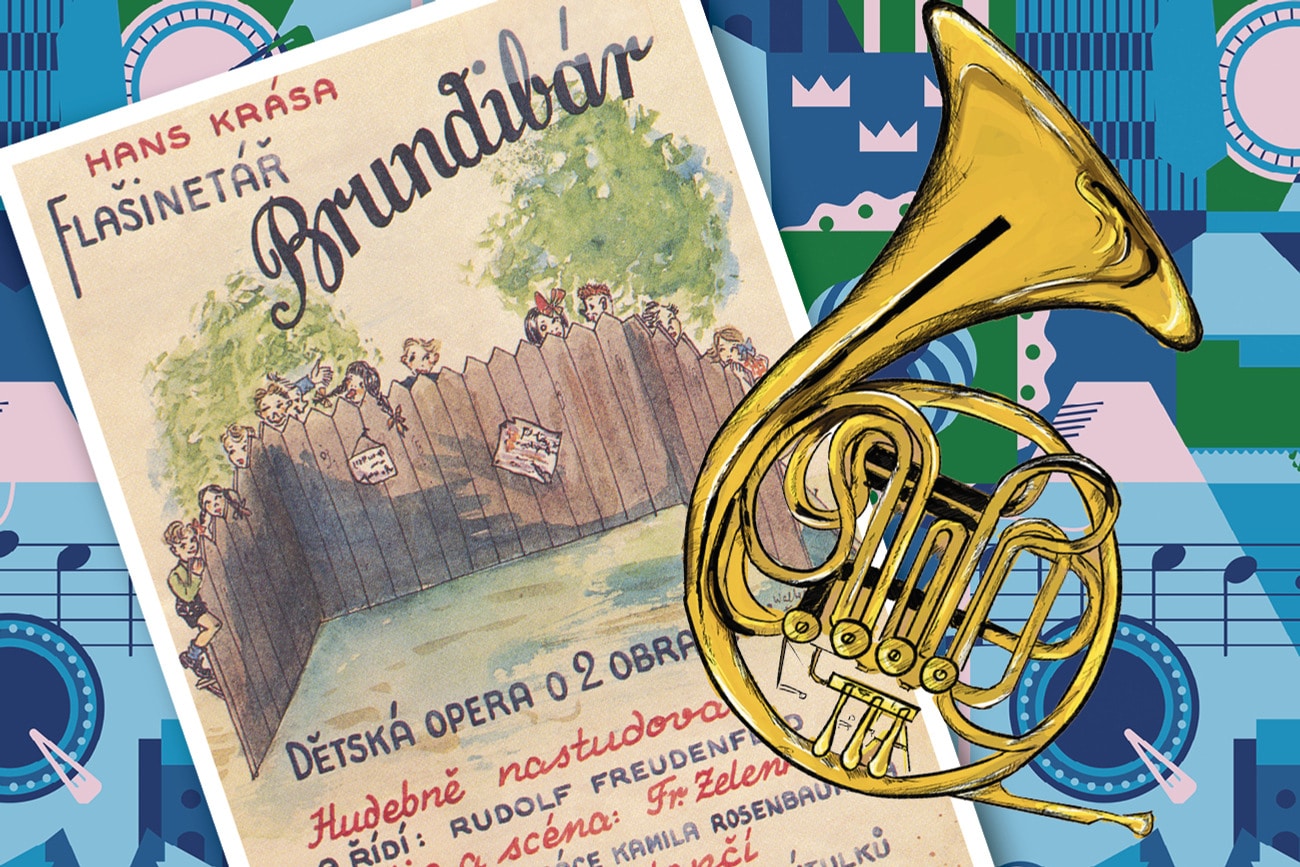
Hans Krása: Brundibár, 25 min
30-minute break
Ernst Bloch: In Memoriam, 5 min
Georg Riedel: Schloft Ale, 5 min.
Thread: Öfn veg shteyt a boym, arr Benjamin Staern, 5 min
Aaron Copland: Appalachian Spring, 25 min
More about the concert
The Mini-Opera *Brundibár*
During this concert, before intermission, we will hear Hans Krása’s mini-opera Brundibár (Czech for Bumblebee). Brundibár was written for children in 1938 in Prague. The plot is as simple as it is heartwarming. The circumstances, however, are the darkest imaginable. The opera was first staged in 1942 at a Jewish orphanage in Prague before both the composer and several of the child actors were deported to the Theresienstadt concentration camp. After two months of rehearsals there—constantly interrupted as the participating children were taken to other concentration camps and replaced by new arrivals—the premiere took place in September 1943. Brundibár – in Theresienstadt. The performance was staged 55 times, and when the camp was to be showcased as a “model ghetto” for Red Cross personnel in the spring of 1944, the Nazis also produced a propaganda film featuring the opera. The film can still be viewed on YouTube today; The Führer Has Given the Jews a Town.
On October 16, 1944, Krása is deported to Auschwitz-Birkenau. He is gassed to death two days later.

Photo from the performance 1942–43.
In Memoriam and Appalachian Spring
Act 2 continues with music by Ernst Bloch. Ernst Bloch (1880–1959) was a Swiss-Jewish composer, a citizen of the United States since 1924. As a composer, Bloch sought to create a national Jewish art music. In doing so, he has been more associated with Jewish psyche and character than with folk music. He has a rhapsodic free musical language. In 1952 he composed the piece In Memoriam , which he dedicated to the pianist Ada Clement, who died the same year.
The evening concludes with *Appalachian Spring*, a ballet by Aaron Copland. Copland was born in 1900 in Brooklyn, New York, to Jewish immigrants from Lithuania. The work was composed in 1943–44 for the American dancer Martha Graham and earned Copland the Pulitzer Prize in 1945 for best stage work of the season. The ballet depicts a pioneer community in the mountains. A young man gets married and settles down, and the pioneers come to offer their congratulations and bless the house. This takes place on a spring day in the early 1900s. The music is largely based on Native American and European folk music, dance melodies, and hymns, and consists of eight movements played in sequence. The seventh movement consists of variations on a melody that Copland drew from the Shakers, a religious sect.
Magnus Larsson, born in Denmark in 1992, began his musical career as a violinist and pianist. At the age of 21, he turned his passion to conducting and has since developed a distinguished career in orchestral music.
Magnus Larsson is one of Scandinavia’s most promising young conductors with a rapidly growing international career. His work spans opera, symphonic repertoire, and contemporary music, and he has collaborated with leading orchestras and opera houses in the Nordic countries and Europe. Among his most recent successes are debuts at the Gothenburg Opera, the Helsingborg Symphony Orchestra, Wermland Opera, and Norrlandsoperan, as well as recurring engagements with several of Denmark’s leading symphony orchestras.
Larsson made his breakthrough with an acclaimed debut at the Royal Danish Opera in Copenhagen with Carl Nielsen’s *Maskarade*, followed by engagements as assistant conductor for Shostakovich’s *The Nose* and Mozart’s *Così fan tutte*. His innovative interpretation of Monteverdi’s *L’Orfeo* with the Copenhagen Phil at Teater Sort/Hvid has garnered significant attention for its artistic boldness. He has also conducted works by Per Nørgård, Puccini, and Verdi, and has appeared at festivals such as the Rued Langgaard Festival and the Njord Festival. In the concert context, he has collaborated with ensembles such as the Danish Radio Symphony Orchestra, the Gävle Symphony Orchestra, the Norrköping Symphony Orchestra, and international orchestras such as the North Czech Philharmonia.
Magnus Larsson has received several prestigious awards, including the Carl Nielsen Talent Prize, the Léonie Sonning Talent Prize, and the EMA First Prize in Prague. He studied at the Royal Danish Academy of Music and the Royal College of Music in Stockholm, and has honed his conducting skills through master classes with Alexander Vedernikov and Fabio Luisi, among others.

Tonight’s host, Sofia Berg-Böhm, is both an actress and a singer. Sofia was introduced to Yiddish music as a teenager when she began singing in her uncle’s klezmer orchestra, an experience that proved decisive for her career choice. As a freelance actress and musician, she moves back and forth between theater and music and across different musical worlds.
She studied classical Arabic music during her time at the Academy of Music and has collaborated on several projects with Re:Orient and oud master Mousa Elias. She has recorded albums and performed in a variety of ensembles, including the groups Östblocket, Sirocco, and Eislerz.
In recent years, she has been a key force in the revitalization of the minority language Yiddish, including her involvement in the creation of a new song collection featuring new and classic songs by Georg Riedel in Yiddish. This year, together with the Camerata Rubinsztein string quartet, she performed the world premiere of the work *Letter to My Child*—a poem by Ilse Weber written in Theresienstadt in 1943 and set to music by Benjamin Staern. As an actress, she has appeared in productions at theaters such as the Stockholm City Theater, Malmö Opera, Unga Klara, and Teater Tribunalen.
Sofia studied at the Malmö Academy of Drama and the Royal College of Music in Stockholm, and in 2017 she was awarded the Royal Swedish Academy of Music’s Folk Music Prize.

Violin I
Dana Kahriman, Martin Granström, Miguel Chamorro, Kitiara Braune, Matias Malmqvist, Per-Erik Andersson, Kersti Wilhelmsson, Lina Samuelsson
Violin II
Pontus Björk, Andreas Olsson, Amandus Lind, Lisa Erpelding, Mikhail Zatin, EvaBritt Molander, Håkan Svedell
Viola
Ester Forsberg, Pablo Muñoz Salido, Karolina Bednarz, Fraser Keddie, Patrick Rutland
Cello
Florian Erpelding, Bekhbat Tsagaanchuluun, Kristina Tereschatov, Kerstin Isaksson, Karin Bjurman
Double bass
Jan-Emil Kuisma, Charlotte Petersson, Josefin Landmér
Flute
Ebba Wallén, Georgiana Hughes
Oboe
Mats Wulff, Johannes Ögren
Clarinet
Tania Villasuso Couceiro, Jonas Olsson Hakelind
Bassoon
Emily Hultmark, Maria Kindell
Horn
Orvar Johansson, Yerang Ko, Edna Fernandes, Anders Kjellberg
Trumpet
Malin Silbo-Ohlsson, Benjamin Mortensen
Trombone
Peter Nygren, Daniel Bjerhag Hedin, Mathias Petersson
Tuba
Linus Mattsson
Timpani
Ian Piniés
Percussion
Maximiliano Polo, Per Mikaelsson
Harpa
Tanne Harder
Piano
Jonas Olsson
Learn more about the Norrlandsoperan Symphony Orchestra here: norrlandsoperan.se/norrlandsoperans-symfoniorkester
Sara Ribbenstedt is a versatile performing artist active in theater, opera, and dance. With a background as an actor and dancer—having trained in the Mime Acting program at the Stockholm University of the Arts—she has primarily worked as a director and choreographer since 2021. Among other projects, she has directed the newly written opera *PMSIUS*, which was selected for the 2025 Performing Arts Biennial.

Ella Vahtras, a mezzo-soprano, was born and raised in Linköping. She has studied at institutions including the Kapellsberg Opera Studio in Härnösand and the Royal College of Music in Stockholm. She is an active freelance musician and has performed as both a soloist and a chorister in several masses and oratorios. In the spring of 2025, she performed as the Evangelist in the St. Luke Passion by Martinsson/Greider. In 2025, she earned her master’s degree from the Piteå School of Music, where she studied with Katherine Osborne. This year, she is studying at the Norrlandsoperan Opera Studio (ONO). There, she will also perform as a chorus member in this spring’s production of *Tosca* at the Norrlandsoperan.

Jenny Viklund is a soprano and earned a bachelor’s degree in opera from the Academy of Music and Drama in Gothenburg in 2021. Her previous roles include Papagena in *The Magic Flute*, Susanna in *The Marriage of Figaro*, Greta in *Hansel and Gretel*, and Suor Genovieffa in *Suor Angelica*. She has performed with the Nordic Chamber Orchestra and the Thüringer Symphoniker and was a finalist in the Wagner Society of Gothenburg’s singing competition in 2024. Jenny is also one of the first two students in the collaborative project Operastudio Norrlandsoperan (ONO), a new one-year master’s program at the Piteå School of Music. The aim is to provide aspiring opera singers with practical experience in the profession while they are still in school.

Swedish bass-baritone Markus Schwartz has a long list of roles in opera and as a concert soloist. Markus Schwartz received his training at the Sibelius Academy in Helsinki and at the Stockholm Opera Academy. He has appeared in roles such as the Sacristan in Tosca, Leporello and Masetto in Don Giovanni, Dr. Bartolo in The Barber of Seville, Monterone in Rigoletto, Schaunard in La Bohème, Alidoro in Cinderella, Barone Douphol in La traviata, Bartolo in The Marriage of Figaro and Geronio in Rossini’s A Turk in Italy. In the summer of 2023, he was a guest at the Savonlinna Opera Festival, where he appeared as Papageno in The Magic Flute. Markus has performed several times in recent years on the main stage of the Norrlandsoperan, including as Mustafà in the anniversary season’s production of Rossini’s Italian in Algiers fall 2024, as Pappi and Paulafarsan in the world premiere of Jenny Wilson’s The Mistresses Spring 2025. In the fall of 2025, he sang the role of King Marke in the hit production Tristan and Isolde, here at the Norrlands Opera as well.

Lotta holds degrees from the Academy of Music in Gothenburg and Opera Studio 67 in Stockholm. Since 2011, Lotta has been the choir director for the Norrlandsoperan Children’s Choir, where she is responsible for the choir’s vocal development and artistic quality. Lotta conceived and founded the choir, which has since participated in a number of opera productions and concerts.

The Norrlandsoperan Children’s Choir, for ages 8–16, and the Youth Choir, for ages 16 and up, are led by a professional children’s choir director. Here, both musicality and stage presence flourish—completely free of charge. In our choirs, children and young people can immerse themselves in music within a warm community of like-minded individuals who share an interest in singing and the performing arts. Our members, both new and long-time, are happy to share their knowledge and support one another every step of the way. We meet every week to refine our artistic expression, and leading up to each major production, we step up our efforts to ensure a performance that moves the audience.
Are you 8 years old or older, and passionate about singing? Contact children’s choir director Lotta Kuisma if you’d like to join the children’s or youth choir, or if you have any questions.

Pursuant to
Norrlandsoperan is 60% owned by Region Västerbotten and 40% by the City of Umeå. We receive grants from the Swedish Arts Council.
Many thanks to all our donors, sponsors, and partners.