




Björn Säfsten – Excerpt from *Haunted Desire*
Through the reflections of social media, the choreography burrows into a mass production of what constantly overwhelms us. From this emerges a choreography in which three beings, immersed in their seemingly random scrolling, find themselves abandoned in a place where the only thing they can do is practice their own language. By wallowing in their desires and inhibitions, they explore images and emotions in a series of scenes that are as fragile as they are intense.
In *Haunted Desire*, Björn Säfstencontinuesto delve deeply into humanity’s constant failure to communicate and how this affects the individual. In this work, the focus turns specifically to iconography created by men who want to be desired by other men. Here, the dancers have arbitrarily selected clips from the algorithms that are thrown at them on social media. On stage, the autobiographical blends with the fictional, the sought-after with the real, in a hodgepodge of exposed, haunted desire. Do we want to become what we consume?

Elnaz Paiamani & Sahar Taklimi – excerpt from *Open Source*
Neuroplasticity is the brain’s malleable function, which is vital to the existence of humans and all living organisms. The work *Open Source* takes you into a world where you have access to your source code, where you are reminded that change is not only possible—it is natural. Why is this insight so important? Research shows that your abilities and achievements are greatly influenced by the very realization that traits are not fixed, but can be developed through new knowledge and experience.
How can an understanding of the nervous system’s connection between the body and the brain be used to our advantage? What has shaped our identity, and what power does the inner voice we carry with us throughout life hold?
Dancehall is the powerful cultural form that shapes the work’s expression; through the interpretation of fundamental Jamaican movements and forms, a language is created that carries the theme forward. With the sound of the genre’s characteristic bass-heavy rhythms and today’s more modern drum loops, melodic atmospheres are built upon which the movements can rest and be guided.
The creators of the work are the Gothenburg-based dance artists Elnaz Paiamani and Sahar Taklimi. *Open Source* is their first collaborative performing arts piece, following several years of parallel and collaborative work. Their previous productions have explored themes such as cancel culture, exclusion, and cultural belonging. Their work is characterized by a physical and musical expression, in which Sahar uses Dancehall and Elnaz uses both Locking and Dancehall as tools to portray and communicate issues that reflect their contemporary world.
Philip Berlin – Excerpt from *La Ronde*
Maxime Denuc’s music, composed for the sonic world of the pipe organ, moves between the repetitive pulse of club music and the instrument’s spherical intensity. The primary instrument for the work is the organ at St. Antonius Church in Düsseldorf.
Parallel to the choreographic process is a digital-archaeological approach: an anachronistic use of a tool inspired by Merce Cunningham’s DanceForms software, a groundbreaking artifact from the early 1990s. This method builds a bridge between digital historicity and contemporary choreographic inquiry.

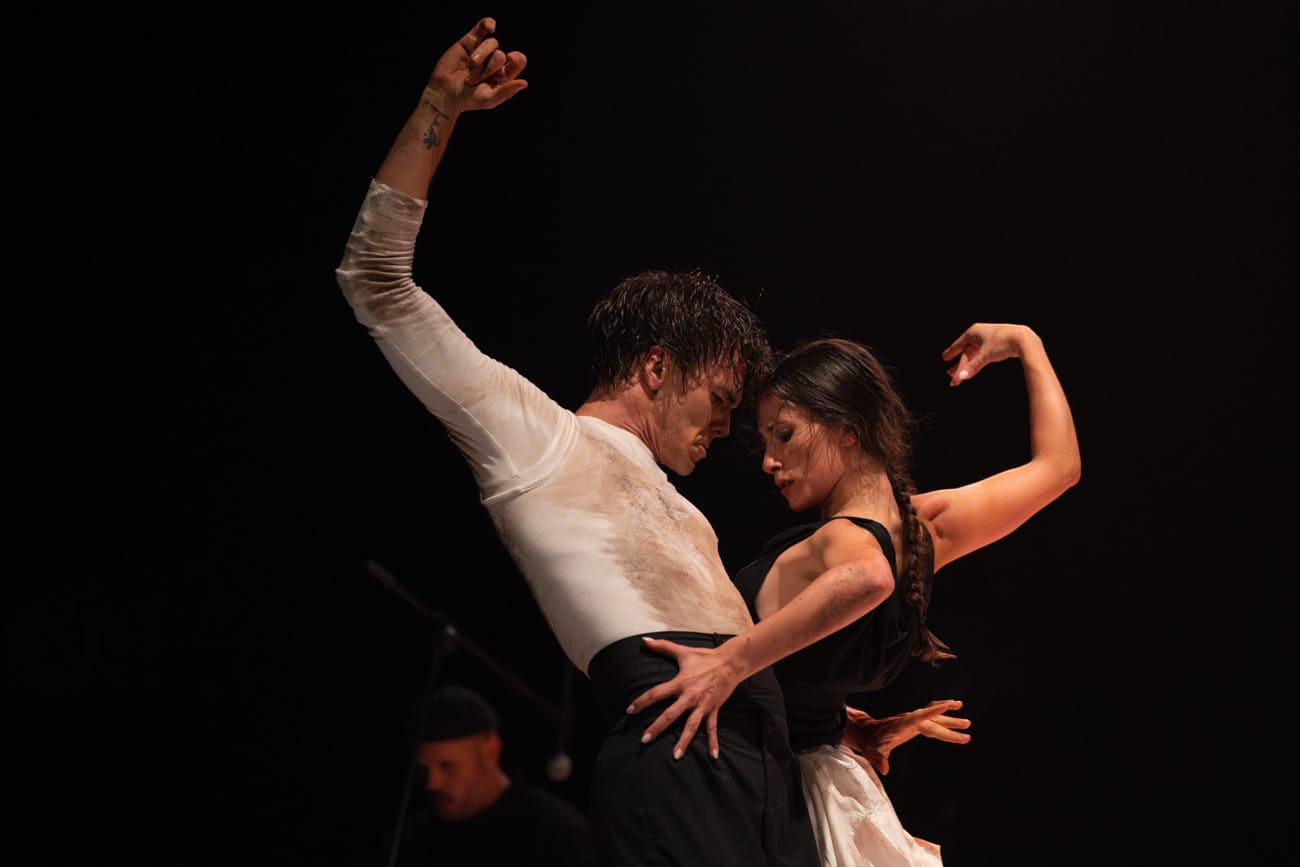
La Venidera – excerpt from NO
Irene Tena and Albert Hernández, the two members of La Venidera, were formerly dancers and soloists with the Ballet Nacional de España. But these two leading figures in the dance world wanted to go beyond their work with the company to push the boundaries of flamenco and Spanish dance.
That is exactly what they do in *No*, where they present a negative world—a universe of absence, flaws, and voids—a denial of reality that opens the door to art. Their exploration of the friction between tradition and the modern world offers a new perspective on the language of Spanish dance.
As artistic advisors, they are led by Marcos Morau, a prominent figure in contemporary dance and the artistic director of the La Veronal dance company.
These two acclaimed dancers explore Spanish dance and flamenco from a contemporary perspective. Their starting point is denial, questions, and absence, as they believe that art arises from the denial of the real world.
Irene Tena and Albert Hernández take us into their most personal universe, where they explore questions about who they are and what has shaped their journey in recent years. It is a vision of flamenco dance through the eyes of young artists born in the late 1990s, fascinated by pushing the boundaries of what Spanish dance and flamenco can be—always evolving and in touch with a changing and tumultuous world.
Bringing tradition and innovation together creates the perfect space for asking questions and conveying a new, contemporary, and generational perspective on Spanish dance.

Sophie Augot & Philip Berlin – excerpt from MISS
Actress and icon Anita Ekberg had a lot to say when she appeared on the radio program *Sommar i P1* in 2005. Her unique approach to the assignment captivated performing artists Philip Berlin and Sophie Augot, who have listened to the program together countless times—and very carefully at that.
They were so captivated by Anita’s distinctive language and husky voice that it took root in both their bodies and their imaginations. This became a catalyst for embodying and choreographing Anita’s enchanting soundscape. Unpredictable whims branched out through associations, and in the interplay between intense presence, physicality, and babbling, a universe took shape with its own internal logic. In the program, Anita talks about how she ended up in Hollywood, about her encounters with Frank Sinatra, Judy Garland, and other more or less famous figures. The program also explores themes such as wine, animal cruelty, olive trees, and “royal Swedish jealousy.”
You are invited to a performance in which the cast, with great love and fearlessness, navigate Anita’s life story to bring out more characters and nuances.
About Production
By listening to the program over and over again, the artists allowed Ekberg’s language and tone of voice to take root in their bodies and imaginations, resulting in a physical and comical performance that embodies the “Sommarprat” and allows the audience to step into a new universe where reality blends with dreams and memories.
We are presented with a dreamlike portrayal of the summer program, in which Anita—channeled through Berlin and Augot’s quirky and comical stage characters—tells the story of her life: from Miss Sweden to Miss Universe and on to Hollywood, where she rubbed shoulders with celebrities like Frank Sinatra and Judy Garland. Amid the torrent of staged thoughts are reflections on olive trees, animal cruelty, “the royal Swedish jealousy,” but also a longing for a “companion.” The experience is enhanced by a dynamic soundscape featuring music from Anita’s films, Italian pop, and contemporary pop.
MISS issomething as unique as a summer talk show brought to life, filled with original turns of phrase taken to their physical extreme. The performance is entertaining, absurd, moving, and unpredictable—with an atmosphere reminiscent of David Lynch. We encounter episodes from Ekberg’s life as her thoughts and feelings are woven into the hypnotic flow of dialogue, movement, and music. A guest performance by and featuring Sophie Augot and Philip Berlin, with two performers on stage and in the audience.

Armin Hokmi – Bazm
Ludvig Daae & Marcus Baldemar – excerpt from *Perfect Lover*
According to Plato, the highest form of love was that which existed between souls—a concept based on the very idea of love. At that time, this referred to relationships between men, which were considered superior to those between men and women. The philosopher and feminist bell hooks’ definition of love serves as a counterpoint to “love as a pure idea”; that love is a verb, involving trust, care, devotion, respect, recognition, commitment, and open and honest communication.
The title of the work is taken from one of the tracks on Britney Spears’ album *Blackout* (2007). Around the time of the album’s release, Spears suffered a public breakdown. Her drastic change in appearance and behavior subverted the image of a pop star by embodying the grotesque. That same year, Ludvig and Marcus met while studying in Brussels. Their relationship began precisely during a conversation about Spears and *Blackout*. As students of contemporary dance techniques strongly influenced by postmodernist ideas and values, they felt that the concept of a so-called “neutral body” was being promoted. White, slim, cisgender, normatively functional bodies had no significance beyond the form they performed. Although Marcus and Ludvig fit these descriptions—and are thus limited in what they can represent and, consequently, challenge—they seek to question these values and queer their dance history. Just as bell hooks serves as a counterweight to Plato’s patriarchal theories, Spears—as a monstrous, emotional pop icon—can serve as a counterweight to expressionless, form-based postmodern dance.
Perfect Lover is not a work about Spears but a space for intimacy featuring phallic and yonic symbols. Featuring holes, fluids, and flesh: a shared, physical experience of love as a practice. The audience is invited to witness two erotic, lustful, and emotional characters dressed in garments that reference both ancient Greece and a modern pop diva. Their contorted, grotesque, and at other times expressionless dancing bodies engage in something that can be perceived as private. Through voice, gaze, and a caress, the audience is drawn into the lovers’ world. They move among a set design consisting of towels: one shaped like a swan, one wet and heavy, and a third, stiffened by an unidentifiable liquid, standing upright on the floor. The towels speak to homoeroticism and spaces with sexual undertones that are important to male, queer history. Marcus and Ludvig’s unique friendship can exist in erotic situations without the nature of their relationship changing. This is something they want to portray in Perfect Lover: sex in the room, not in the relationship. Using in-ear headphones, the two performers listen to “Blackout,” which serves as a private dramatic compass and a source of emotions and connection. The audience experiences the work through a different soundscape. The two soundscapes frame the work as a play on the private and the public. At times, the two worlds intertwine and overlap.
Ludvig Daae
I have been creating my own performances since 2011, as well as works for Cullberg, the Royal Swedish Ballet School, KHiO, and Norrdans. In addition to *Perfect Lover*, I’m currently working on two projects: *The Meaning of Life*, an interactive trailer park I’m creating in collaboration with Tove Berglund, and *Attempting Alchemy* for Skånes Dansteater. I have an ongoing collaboration with film director Joanna Nordahl. Together, we’ve created MM, HYPERFRUIT and The Viral Dance all of whom have toured with Dansnät Sverige and Dansnät Norge. My performances have been presented in 14 countries at venues such as Den Norske Opera (NO), Sophiensaele (DE), The Place (UK), Vooruit (BE), Gessnerallee (CH), Moderna Museet (SE), Biennale de danse de Val du Marne (FR), MDT (SE), Brut (AT), GUIdance (PT), Dansens Hus (SE), and Zodiak (FI).
My goal is to create dance that challenges norms of masculinity and highlights “radical softness” as an alternative. In a society that rewards toughness, I find strength in softness by allowing emotions in the studio, trusting and leaning on others, and letting this approach inform my artistic expression. Softness as a working method and artistic expression stands in contrast to today’s neoliberal notions of individualism and autonomy.
By staging a universe with its own rules, logic, and interpersonal relationships, my performances offer alternatives to the world outside the theater. Taking “what if” as a starting point (what if ballet looked like disco (Dance To Dance To), what if folk dance were created today (We can do whatever you want)), and through drastic, rapid dramatic shifts, “queers” time. This challenges the audience’s perception and understanding of the play’s future development. The goal is for them to surrender to the feeling of the “here and now.”
Marcus Baldemar
My work seeks to convey a non-hierarchical relationship between the emotional, the physical, and the intellectual. A recurring interest of mine is finding and/or creating connections between a poetic/political body and a poetic/political language. This is an open, ever-evolving question that guides me in my work. The writer Leslie Feinberg once said that “gender is the poetry we make of the language we are taught.” In my work, I also see movement and the body as the poetry we create from the language we learn. I often work with text, but ultimately, the body is the primary communicator.
I think it’s important to “see it from the inside” as opposed to “just looking at it.” I believe that the stories being told concern those who represent them.
My starting point is often queer history and storytelling, as well as the ambition to queer history and storytelling. In my solo GALDR (2019) I explored Norse mythology from a queer perspective and danced/told an alternative story based on the Norse god Odin. With Polari: Speaking, Sex (2021) I was inspired by a secret language spoken among gay men in England from the early 1900s through the mid-1960s. Together with my colleagues, we explored the idea of a secret form of communication that made it possible to safely express and share queer joy, pleasure, and intimacy in public. In Finally Fantastic (2022) depicts a sense of togetherness that extends even into death. It explores how dying coexists with the imaginative, joyful, and intimate. The work can be seen as a meeting place and a shared burial ground where a group of people from different generations live, die, and are together. As in previous works, I took history as my starting point to create a work that speaks to the present. We die the death we wish to die—together!
Marcus collaborates regularly with MDT in Stockholm and has presented his works throughout Sweden. He has also created works for the Riksteatern. In 2024, his latest choreographic work—created for both theaters and galleries—will premiere: *Sex & Tornedalen* will be presented in Luleå, Stockholm, and Oslo.

Medeleine Lindh – Wildstyle
The dance shatters these linguistic costumes through a four-minute cavalcade of weight shifts, influenced by a rear-heavy forward movement in a delayed climax. These wild styles represent a hopeful speculation about an extended choreography, one that will find its place in a coming and, hopefully, flourishing era for dance.
The choreography is named after the artist Wildstylez, who creates electronic dance music in the hardstyle genre, which originated from hardcore techno and is influenced by hardtrance and hard house.
Madeleine Lindh
Madeleine Lindh, born in 1985 in Stockholm, is a Swedish dancer and choreographer who has worked internationally with choreographers such as Wayne McGregor, William Forsythe, Angelin Preljocaj, and Frederic Flamand. Her dancing has been shaped by her studies in ballet at the Royal Swedish Ballet School and in the Isadora Duncan technique under the guidance of Kathleen Quinlan Zetterberg. A number of close and long-term collaborations in Sweden with fellow dancers and choreographers have been important to her artistic development. These include Björn Säfsten, Linda Blomqvist, and Philip Berlin, as well as Anja Arnquist, with whom she has danced, conversed, written, and choreographed for 15 years. For more than a decade, she was affiliated with Ccap and the Golden Lion-winning choreographer Cristina Caprioli. Since 2018, Madeleine has co-led the choreographic duo OR/ELLER with Anja Arnquist.
Madeleine is particularly interested in how dance and choreography aestheticize the body’s own weight in relation to space, as well as in the inherent mystery of dance and performance.
Hagar Malin Hellkvist Sellén – We’re Moving Toward the End
The work was created as a choreographed exhibition for the Västerbotten Museum’s 200-square-meter exhibition hall. The exhibition consists of a seven-part choreographic work totaling nearly six hours. *We Are Moving Toward the End* opened on February 17, 2024, and ran for three weeks.
www.malinhellkvistsellen.se