Opening Remarks
Opera Director Dan Turdén — On Everything That Happened Before

How went that to when Norrland Opera drug getting started his largest international co-production Ever? Our artistic editorial within opera says.
I’d like to apologize in advance to readers for some name-dropping. Every person mentioned has played a vital role in making it possible for Norrlandsoperan to present *The Galloping Cure* to you tonight. There isn’t enough space here to list everyone who contributed from start to finish—there are simply too many to count. This is the story of what happened before there was a libretto, before there was music, before singers and a director were needed, before a conductor began leafing through a score, before tickets could be sold.
As the newly appointed opera director at Norrlandsoperan in the spring of 2021, I saw the 50th anniversary fast approaching. Given Norrlandsoperan’s history of commissioning new operas despite its relatively small size, I felt that the best way to celebrate our 50th anniversary was with a brand-new opera premiere. But who would write it?
I made a short list of names that I knew, in all practical terms, would be impossible to secure, but which were the ones I dreamed of most. At the top of that list was the American composer Missy Mazzoli, already one of the most hyped composers on the international opera scene. I had heard her and librettist Royce Vavrek’s breakthrough work, *Breaking the Waves* — an adaptation of Lars von Trier’s film of the same name—and had been blown away. The intensity of the storytelling, the effective libretto, the melodies, and the soundscape—all of which perfectly capture von Trier’s world while creating something of its own, something independent of its source material.
On a whim, I reached out to Missy and asked to meet with her. We met on Teams. Due to the time difference, I was sitting in the Norrlandsoperan’s smallest guest apartment at Kungsgatan 27 A, which I had rented for a short time, while she was in her studio apartment in Manhattan with a fascinating psychedelic wallpaper as a backdrop. On the wall behind me hung a mass-produced, unframed print of the Brooklyn Bridge.
That meeting was followed by another one, this time attended by publisher Peggy Monastra and Missy’s partner Royce. I don’t remember if the Brooklyn Bridge was visible in the background then either, but it’s not out of the question. For some unfathomable reason, both Missy and Royce were really excited about the idea. There was just one catch: 2024–25 was out of the question due to their already scheduled commitments. I won’t bore readers with the details of how we stayed in touch, but we did, and we agreed to set aside the anniversary year and look further into the future for the seasons that followed.
At Ingmar Bergman’s farm, Hammars, on Fårö in the summer of 2021, Royce asked me what kind of opera I was actually most interested in. It was a difficult question, but I know I blurted out that I was looking for something contemporary—something that’s about us here and now—a story driven by a complex dilemma and an idea that isn’t an adaptation of another work.
In March 2022, I received an email from Royce in which he presented their initial concept for *The Galloping Cure*. The concept was based on a new synopsis by Karen Russell and addressed the spiraling opioid crisis in the U.S., filtered through Franz Kafka’s short story “A Doctor in the Country.” The idea hit the nail on the head in terms of what I had been trying to articulate as what I wanted most from a newly written opera.
But I also realized two things: this couldn’t be a story that became a matter solely for the Norrlandsoperan and the Umeå audience—the idea was too good not to reach a wider audience—and that this would require funding that the Norrlandsoperan couldn’t provide on its own. From our respective corners, publisher Peggy and I tried to spark interest among other opera houses. Even though there was interest, nothing is ever certain in the opera world until “the fat lady sings.” Funding remains a headache. But God hears our prayers.
In October 2022, completely out of the blue, I was contacted by Olle Jansson, the dean of the Theater Academy during my time as a student there, who told me that he was serving as an expert on an evaluation panel for the Riksbank’s Jubilee Fund and, in that role, was reaching out to various cultural organizations in Sweden to gauge their interest in participating in a call for proposals from a new grant program run by the fund, RJ Konst och Kultur. The funding was intended to finance cultural projects inspired by research funded by the Riksbank’s Jubilee Fund. “Quite substantial sums may be available.” “Well, the Norrland Opera is definitely interested,” was my understated reply. A new process began, and through RJ, I was put in touch with researchers Susanne Lundin and Mats G. Hansson, who had conducted research directly applicable to Missy’s and Royce’s idea. They were also interested in letting me review their research for the purpose of writing the application.
To write such an application, you need expertise in both the academic world and the performing arts; personally, I don’t know the first thing about the academic world. There was only one person I trusted to be able to draft such a text so that it would be comprehensible and credible enough to generate the rather substantial sums that would be needed: Kristina Hagström-Ståål, who holds a Ph.D. in performance studies from Berkeley and works as a director herself—intelligent as few others and with a sharp pen. I pitched the idea to her at Balders Bröd in downtown Sollentuna, and she accepted. This was in August 2023. With some help from yours truly, Kristina put together an application that made me very hopeful, but the competition for funding from RJ Konst och Kultur would be fierce, so once the application was submitted, all we could do was keep our fingers crossed. On December 6, 2023, the response arrived. Application approved. Cake at work.
Meanwhile, Peggy, Missy, and Royce had managed to sell the idea to producer John Berry—a legend in the opera world who, through his pro bono production company Opera Ventures Productions, had been instrumental in the enormous success of *Breaking the Waves*, among other projects. Together with John, his team, and his global network, the production was able to achieve the impact that Missy’s and Royce’s idea deserved. And it was probably around this time that the real work of creating the piece and putting together the production began. Perhaps I’ll write more about that another time.
Following its world premiere by our partner, Scottish Opera, at the Edinburgh International Festival, the production has been staged at the opera house on Operaplan. Together with the directing team of Tom Morris and Leah Hausman—themselves titans of the international opera scene—the staff of Norrlandsoperan, both permanent employees and freelance collaborators, have worked harder and with greater dedication than could ever be expected. It has been an exhausting few weeks since August 17 to get the production up and running. Here, I must highlight project manager Esther von Schönberg’s tireless dedication—always with the production’s best interests in mind—and the entire ensemble, led by conductor Jessica Cottis. My heart is filled with humble gratitude for all the hard work that has been put in, after everything that happened before.
The good news is that we are human,
We are blessed with the ability to feel.
The opposite would be devastating:
An inescapable numbness.
I can’t cure you, but I can listen.
You’re begging for answers I don’t have.
There are no simple solutions.
There is no easy solution.
Theresa’s first aria, lyrics by Royce Vavrek
Dan Turdén, Artistic Director of Opera, Norrlandsoperan
Opera Director Dan Turdén—On Everything That Happened Before
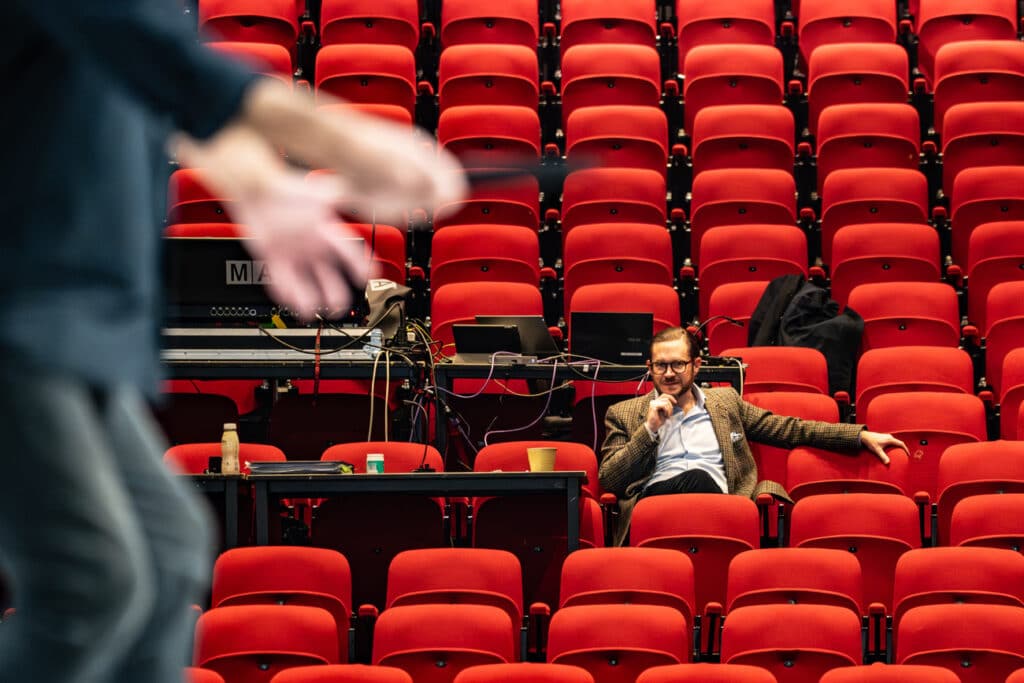
How did Norrlandsoperan launch its largest international co-production ever? Our artistic director for opera explains.
I’d like to apologize in advance to readers for mentioning a few names. Everyone mentioned here played a vital role in making it possible for Norrlandsoperan to present *The Galloping Cure* to you tonight. There isn’t enough space to list everyone who contributed from start to finish—there are simply too many to count. This is the story of what happened before there was a libretto, before there was music, before singers and a director were needed, before a conductor began flipping through a score, before tickets could be sold.
In the spring of 2021, as the newly appointed opera director at Norrlandsoperan, I could see the 50th anniversary fast approaching. Given Norrlandsoperan’s history of commissioning new operas despite its relatively modest size, I felt the best way to celebrate our 50th anniversary was with the premiere of a brand-new opera. But who would write it?
I made a short list of names that I knew, in practice, would be impossible to secure but were the ones I dreamed of most. At the top of that list was the American composer Missy Mazzoli, already one of the most talked-about composers on the international opera scene. I had heard her and librettist Royce Vavrek’s breakthrough work, Breaking the Waves—an adaptation of Lars von Trier’s film of the same name—and had been blown away. The intensity of the storytelling, the effective libretto, the melodies, and the soundscape that fully capture von Trier’s world yet create something of their own, something independent of its source material.
On a whim, I reached out to Missy and asked to meet with her. We met on Teams. Due to the time difference, I was sitting in the Norrlandsoperan’s smallest guest apartment at Kungsgatan 27 A—which I had rented for a short time—while she was in her studio apartment in Manhattan, with fascinating psychedelic wallpaper serving as a backdrop. On the wall behind me hung a mass-produced, unframed print of the Brooklyn Bridge.
That meeting was followed by another one, this time with publisher Peggy Monastra and Missy’s partner Royce in attendance. I don’t remember if the Brooklyn Bridge was visible in the background then either, but it’s not out of the question. For some unfathomable reason, both Missy and Royce were really excited about the idea. There was just one catch. The 2024–25 season was out of the question due to their existing commitments. I won’t bore you with the details of how we stayed in touch, but we did, and we agreed to set aside the anniversary year and look further into the future for subsequent seasons.
At Ingmar Bergman’s estate, Hammars, on Fårö in the summer of 2021, Royce asked me what kind of opera I was most interested in. It was a difficult question, but I know I blurted out that I was looking for something contemporary—something about us here and now—a story driven by a complex dilemma and an idea that isn’t an adaptation of another work.
In March 2022, I received an email from Royce in which he presented their initial concept for *The Galloping Cure*. The concept was based on a new synopsis by Karen Russell and addressed the spiraling opioid crisis in the U.S., as interpreted through the lens of Franz Kafka’s short story“A Doctor in the Country.” The idea perfectly captured what I had been trying to articulate as what I wanted most from a newly written opera.
But I also realized two things: this couldn’t be a story that concerned only the Norrlandsoperan and the Umeå audience—the idea was too good not to reach a wider audience—and that this would require funding that the Norrlandsoperan couldn’t provide on its own. From our respective corners, publisher Peggy and I tried to spark interest among other opera houses. Even though there was interest, nothing is ever certain in the opera world until the fat lady sings. Funding remains a headache. But God answers prayers.
In October 2022, out of the blue, I was contacted by Olle Jansson, who had been the dean of the Theater Academy during my time as a student there. He told me that he served as an expert on an evaluation panel for the Riksbank’s Jubilee Fund and, in that capacity, was reaching out to various cultural organizations in Sweden to gauge their interest in participating in a call for proposals from a new grant program run by the fund, RJ Art and Culture. The funding was intended to support cultural projects inspired by research funded by the Riksbank’s Jubilee Fund. “Quite substantial sums may be available.” “Well, the Norrland Opera is definitely interested,” was my understated reply. A new process began, and through RJ I was put in touch with researchers Susanne Lundin and Mats G. Hansson, who had conducted research directly applicable to Missy’s and Royce’s idea. They were also interested in allowing me to access their research for the purpose of writing the application.
To write such an application, you need expertise in both the academic world and the performing arts; personally, I don’t know the first thing about the academic world. There was only one person I trusted to craft such a text so that it would be clear and credible enough to secure the rather substantial funding that would be required: Kristina Hagström-Ståål, who holds a Ph.D. in performance studies from Berkeley and works as a director herself—a woman of rare intelligence and a sharp writer. I pitched the idea to her at Balders Bröd in downtown Sollentuna, and she agreed. This was in August 2023. Kristina, with a little help from yours truly, put together an application that gave me great hope, but the competition for funding from RJ Konst och Kultur would be fierce, so once the application was submitted, all we could do was keep our fingers crossed.
On December 6, 2023, we received the answer: the application had been approved. We celebrated with cake at work.
In the meantime, Peggy, Missy, and Royce had managed to pitch the idea to producer John Berry—a legend in the opera world who, through his pro bono production company Opera Ventures Productions, has been instrumental in the enormous success of productions like *Breaking the Waves*. Together with John, his team, and his global network, the production was able to achieve the impact that Missy’s and Royce’s idea deserved. And it was probably around this time that the real work of creating the piece and putting together the production began. Perhaps I’ll write more about that another time.
Following its world premiere by our partner, Scottish Opera, at the Edinburgh International Festival, the production has been staged at the opera house on Operaplan. Together with the directing team of Tom Morris and Leah Hausman—themselves titans of the international opera scene—the staff of Norrlandsoperan, including both permanent employees and freelance collaborators, have worked harder and with greater dedication than could ever be expected. It has been an exhausting few weeks since August 17 to get the production up and running. Here, I must highlight project manager Esther von Schönberg’s tireless dedication—always with the production’s best interests in mind—and the entire ensemble, led by conductor Jessica Cottis. My heart is filled with humble gratitude for all the hard work that has been put in, after everything that happened before.
The good news is that we are human,
We are blessed with the ability to feel.
The opposite would be devastating:
An inescapable numbness.
I can’t cure you, but I can listen.
You’re begging for answers I don’t have.
There are no simple solutions.
There is no easy solution.
Theresa’s first aria, with lyrics by Royce Vavrek.
Dan Turdén, Artistic Director of Opera, Norrlandsoperan
Synopsis
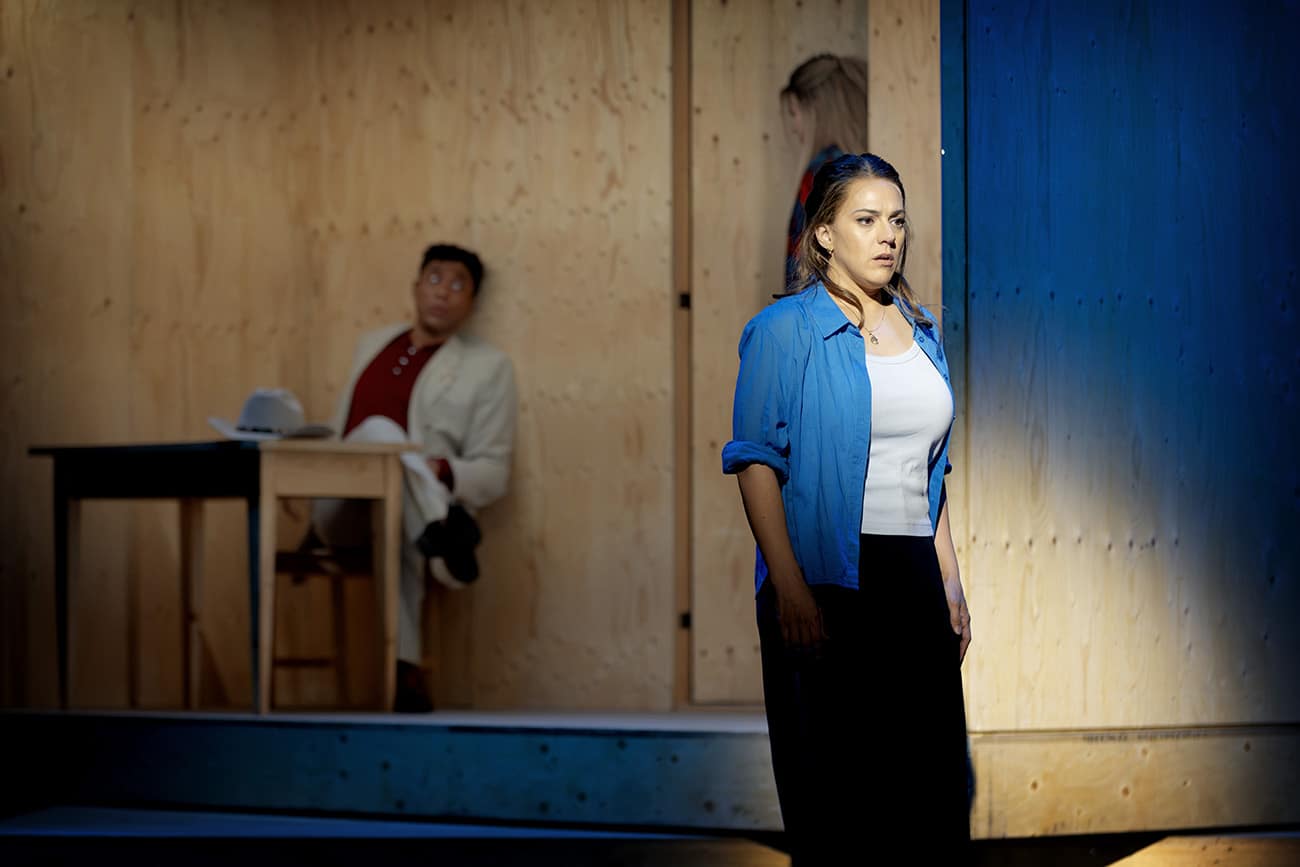
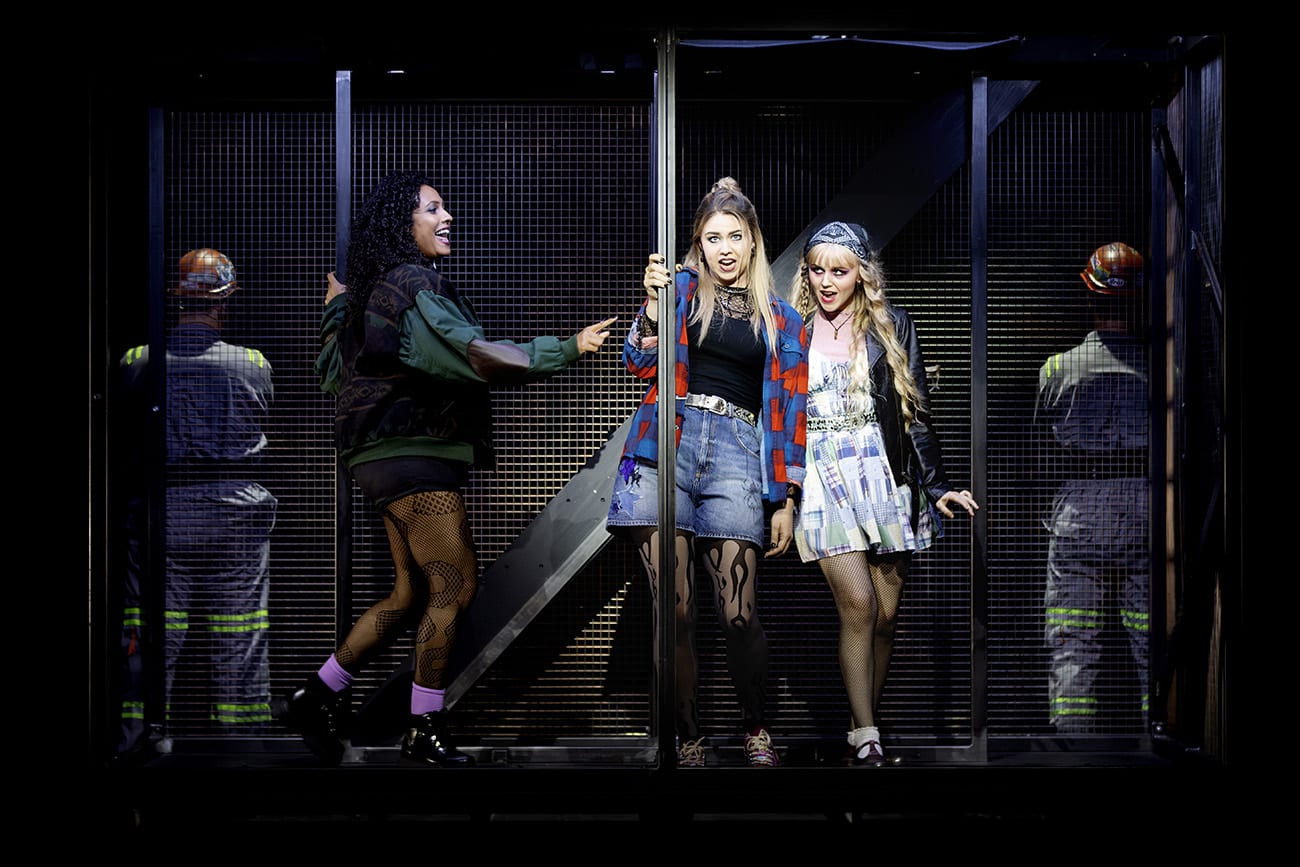
More and more residents of the small industrial town are suffering from chronic pain. Dr. Theresa Hart does her best for her patients, but feels powerless. She herself suffers from migraines. Her teenage daughter, Noy—who has a newborn daughter of her own—looks down on her and calls her a lousy doctor.
In a struggling industrial town, residents are suffering from increasing chronic pain. Dr. Theresa Hart treats her patients with compassion but feels powerless, plagued by her own migraines. Her teenage daughter, Noy, resents her, calling her a “lousy doctor.”
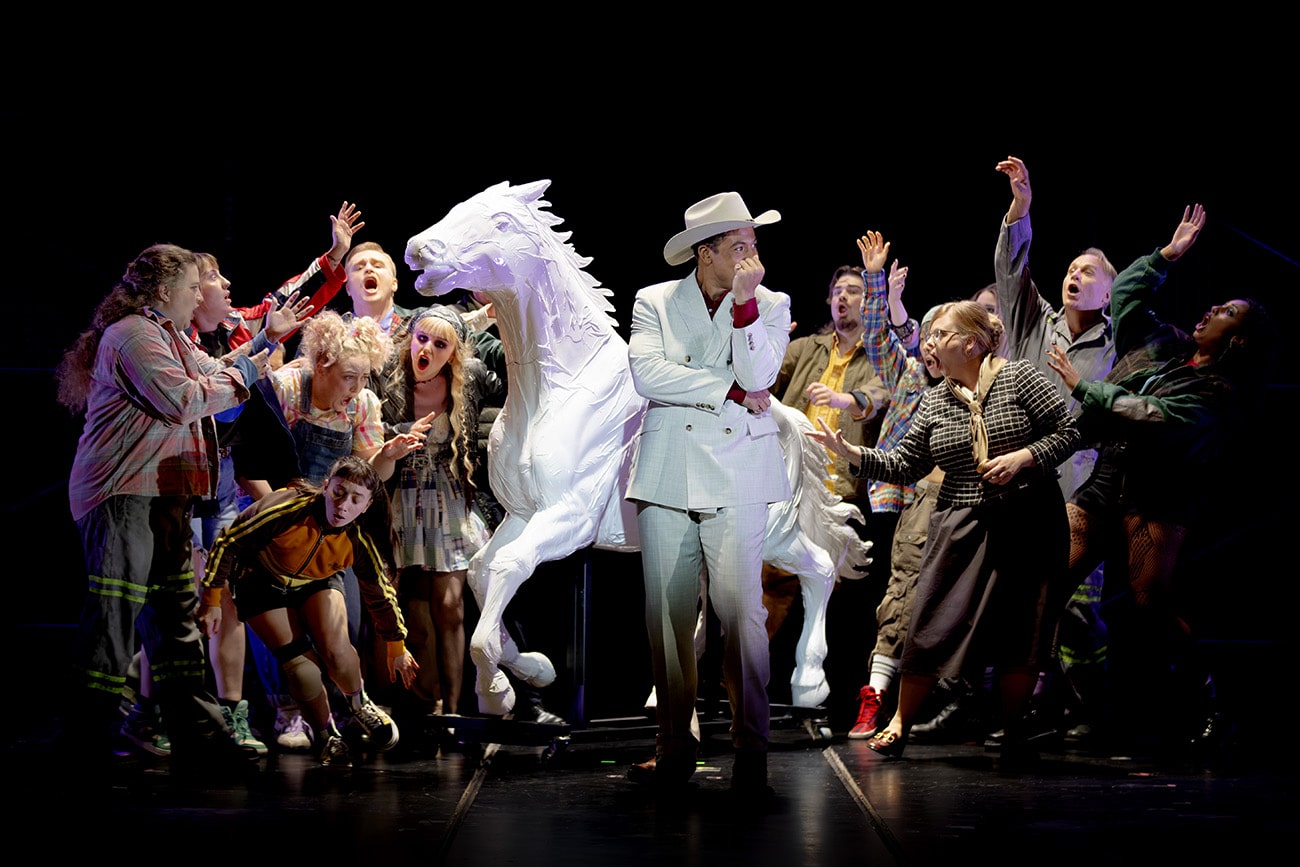
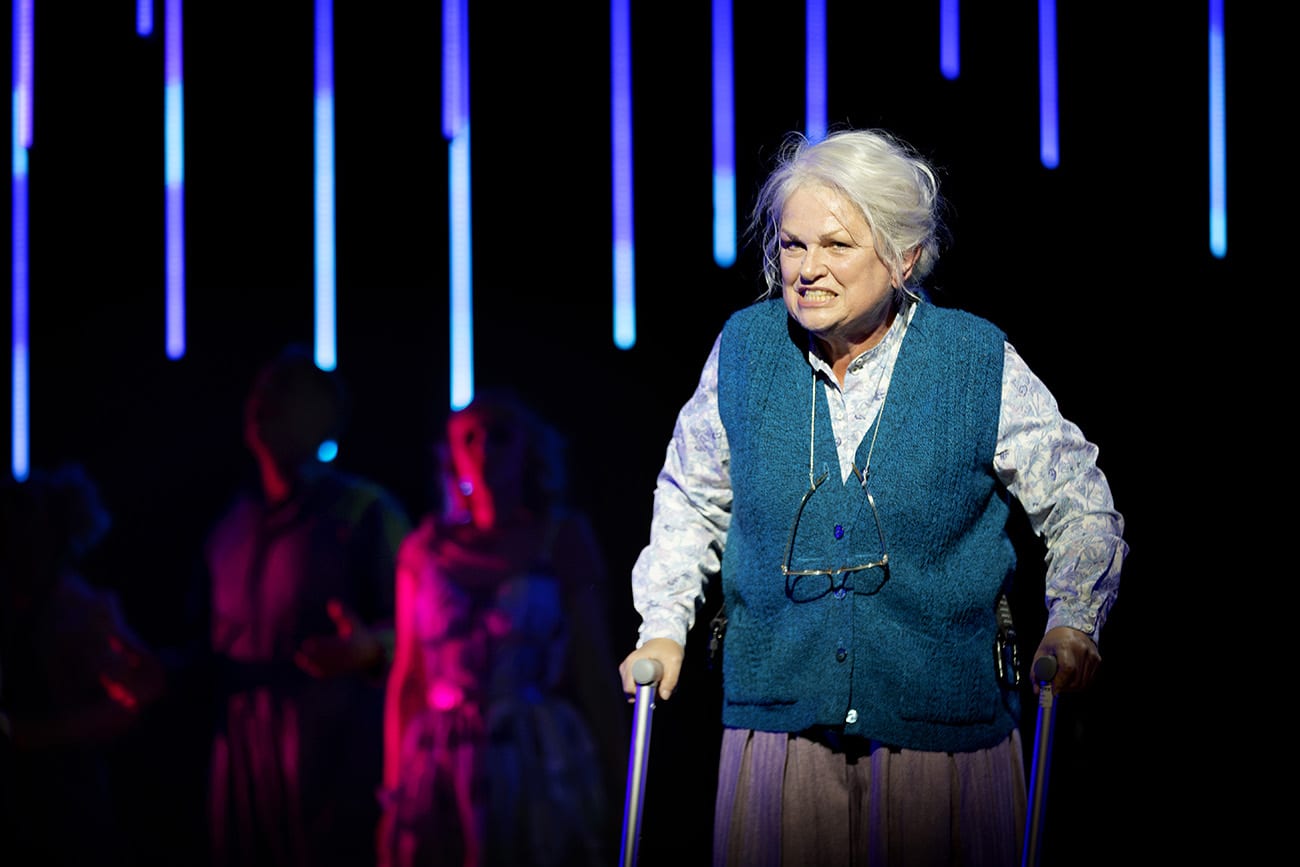
A mysterious carnival comes to town, led by the demonic Lucky Mack. He offers the townspeople a delightful ride on his carousel, The Galloping Cure. People are captivated; even the eccentric skeptic Ivona Kowalski feels the carousel easing her ailments.
A mysterious carnival arrives, led by the devilish Lucky Mack, offering the townspeople joy and relief on his carousel, “The Galloping Cure.” The community becomes enthralled; even skeptics like the eccentric Ivona Kowalski feel relief.
Noy experiences the thrill of the ride and urges her mother to give it a try. Theresa remains hesitant, while the carousel’s allure grows and the city descends into mass hysteria.
Noy experiences the thrill of the ride and urges her mother to try it. Theresa remains skeptical, but the town descends into mass hysteria as the carousel’s allure grows.
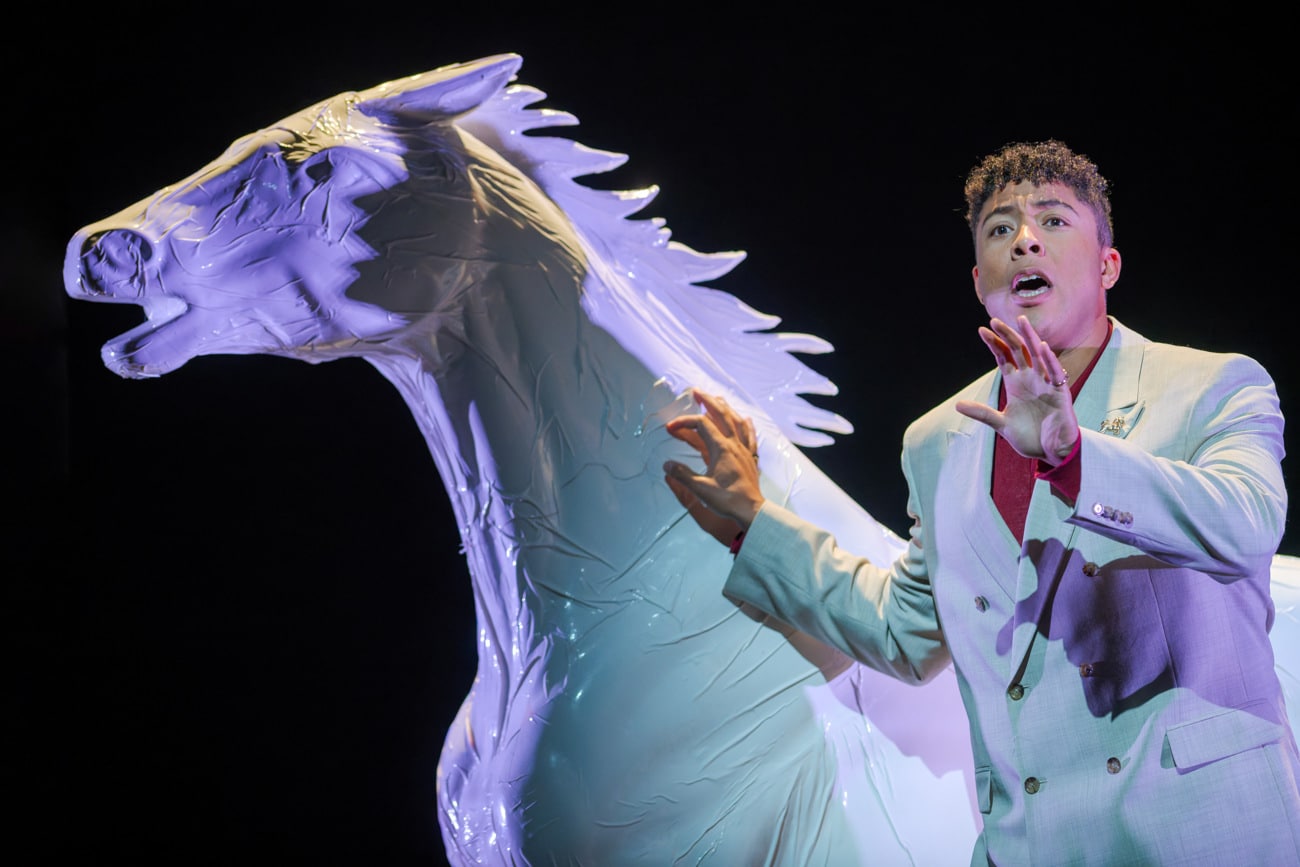
The mayor hails The Galloping Cure as an economic miracle. Theresa throws her support behind Lucky Mack and becomes his partner. Demand skyrockets, and fights break out. Mack introduces dynamic pricing and a limit of two rides per week.
The mayor hails the Galloping Cure as an economic miracle, and Theresa publicly endorses it, partnering with Lucky Mack. Demand skyrockets, fights break out, and Mack implements dynamic pricing and a limit of two rides per week.
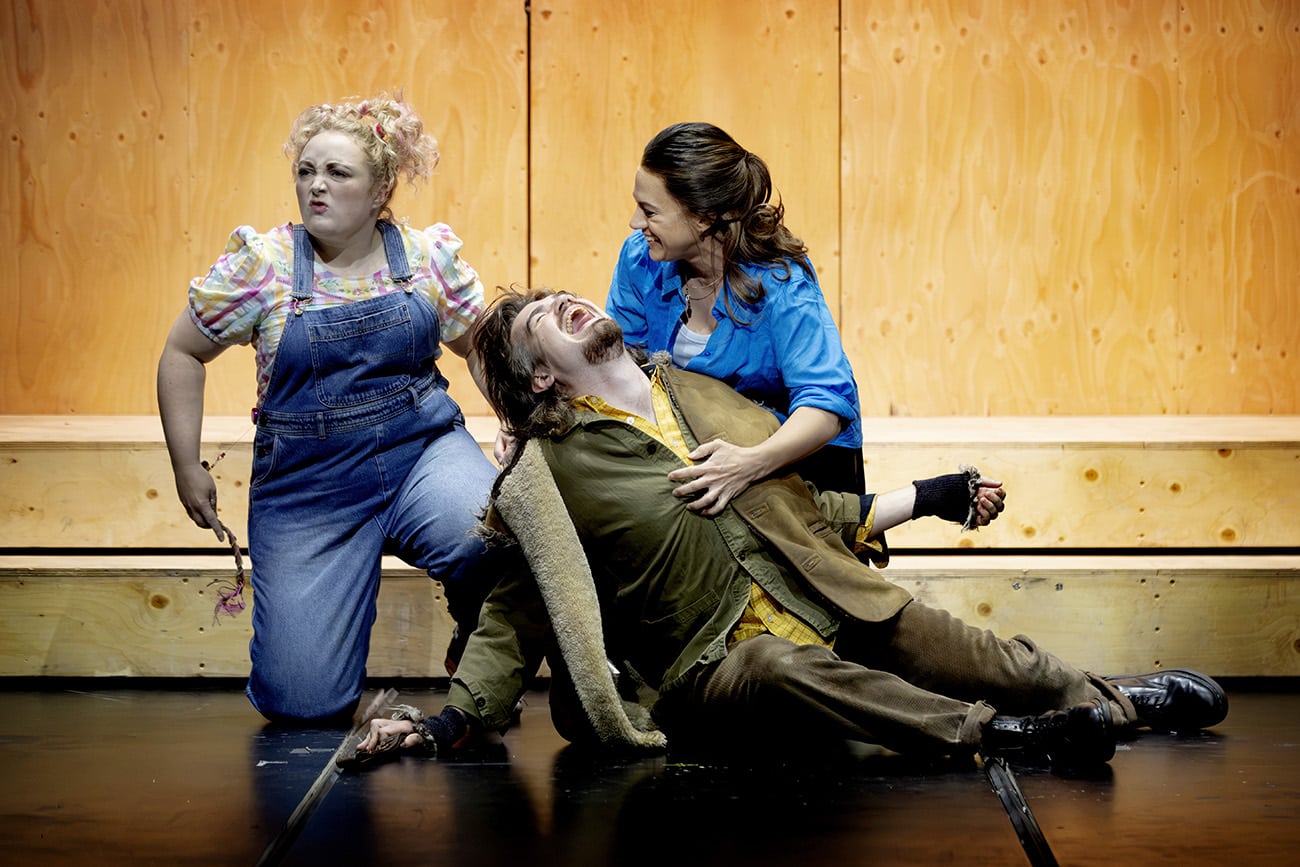
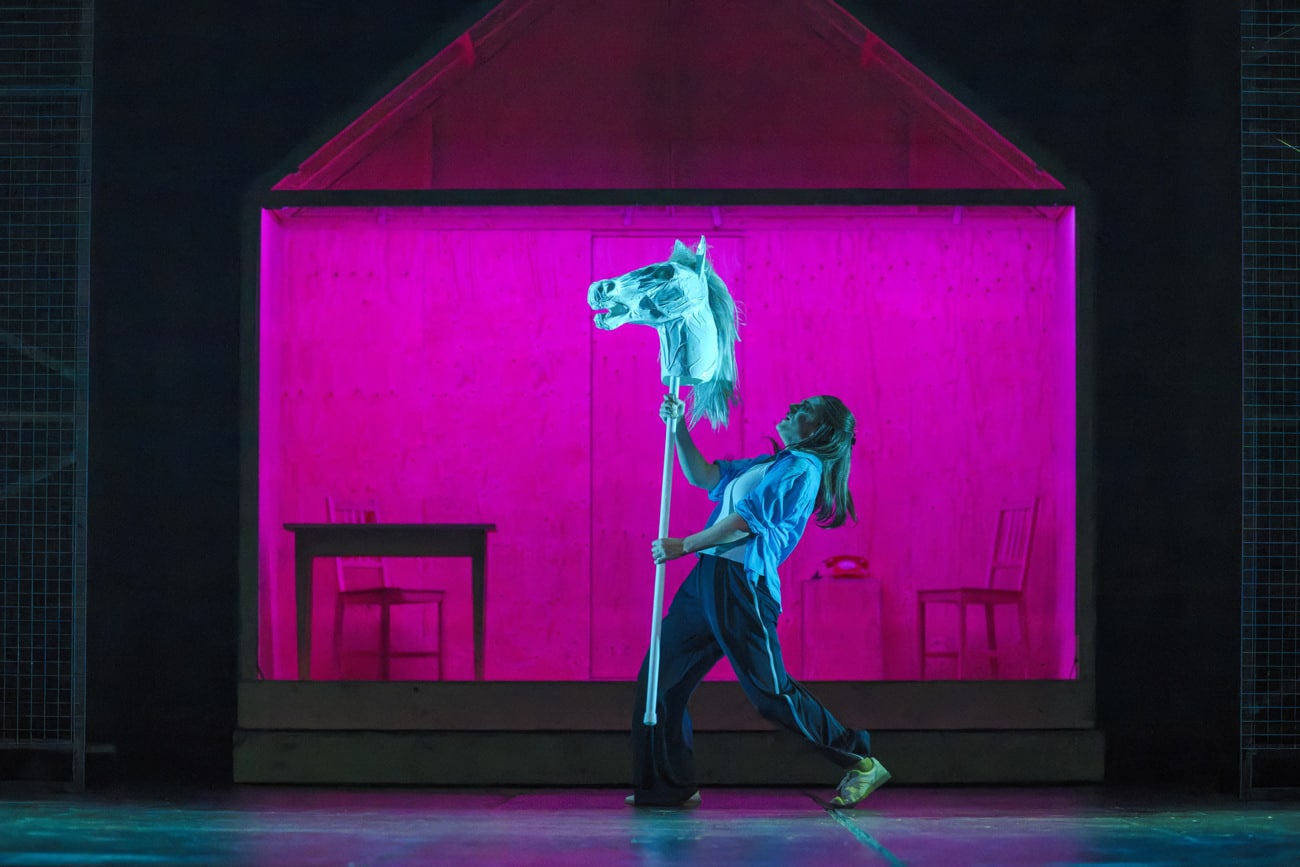
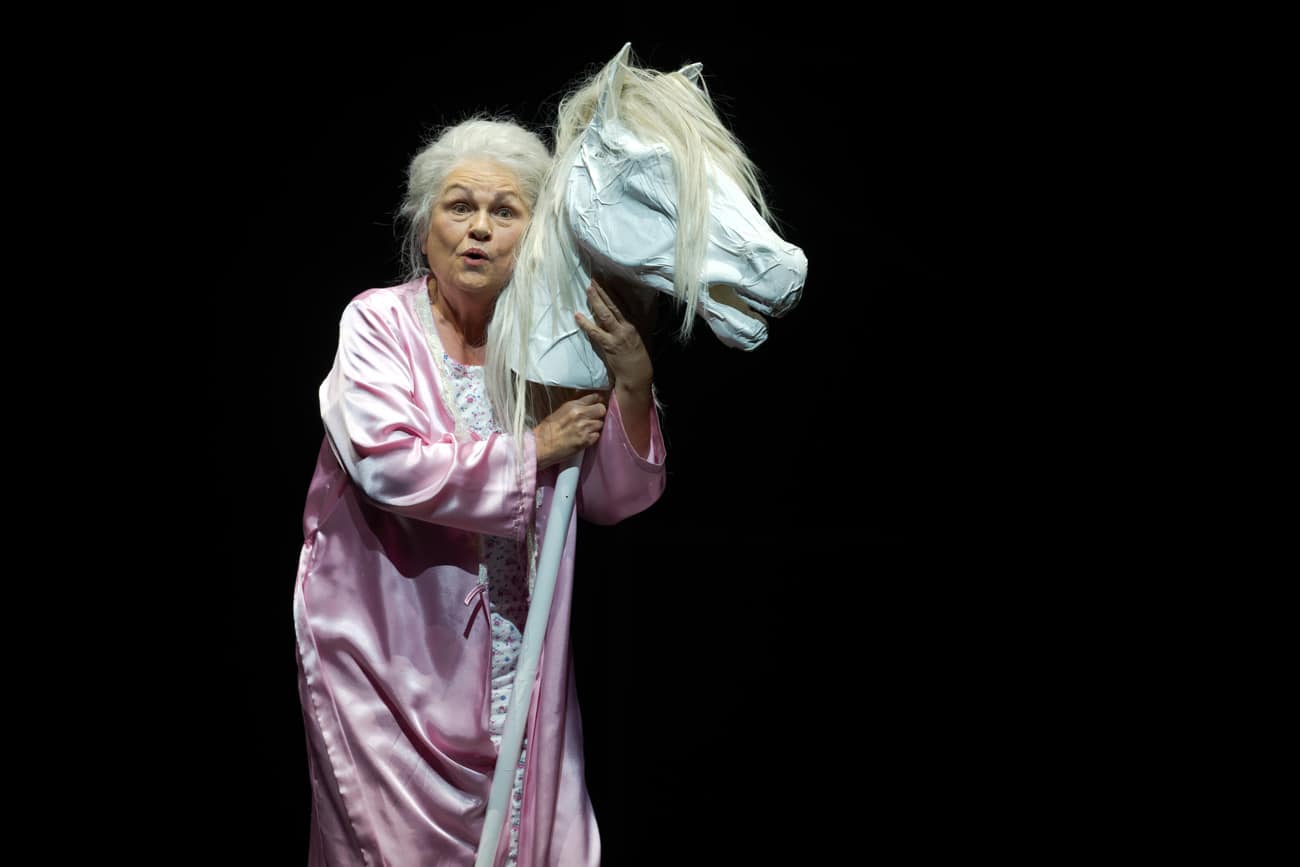
Noy returns home with injuries from the carousel frenzy, but her pain is eased by Home Horse—a hobby horse for personal use provided by Mack. Theresa is curious about the horse, and when she finally gives in, she notices that her migraine is subsiding.
Back home, Noy returns injured from the carousel frenzy but finds relief riding a “HomeHorse,” a stick horse for personal use that Mack provides. Theresa, curious, gives it a try and discovers that her migraines disappear for a moment.
The town’s sheep and dogs sing joyfully as Mack lures Theresa deeper into the fog. Noy and the town’s youth make their way to an abandoned movie theater, where they throw a rave-like party with their Home Horses. They slip deeper and deeper into their addiction and surrender themselves completely to The Galloping Cure.
The town’s sheep and dogs sing joyfully as Mack lures her further in, blurring the line between medicine and miracle. Meanwhile, Noy and the town’s youth retreat to an abandoned movie theater, where HomeHorses turns into a rave-like party. They drift into a dangerous dependence, surrendering their sense of self to the galloping cure.
Act III
Mack persuades Ivona to sacrifice her eyes, her hair, and her body parts to the carousel horses, which, in a macabre way, become one with them. Theresa, exhausted and addicted, is on the verge of giving in completely when she realizes that Noy and the other young people have also been mutilated. She tries to save Noy, who feels as if she’s being ridden by the carousel. Nothing helps, and her daughter dies in her arms.
Mack preys on Ivona, persuading her to sacrifice her eyes, hair, and body parts for his carousel horses, which grotesquely incorporate human remains. Theresa, exhausted and addicted, nearly loses herself before realizing that Noy and the other youths have been mutilated: their tongues, hair, and more taken by Mack. She tries to save Noy, but her daughter succumbs, dying in her arms, convinced she was “ridden” by the cure.
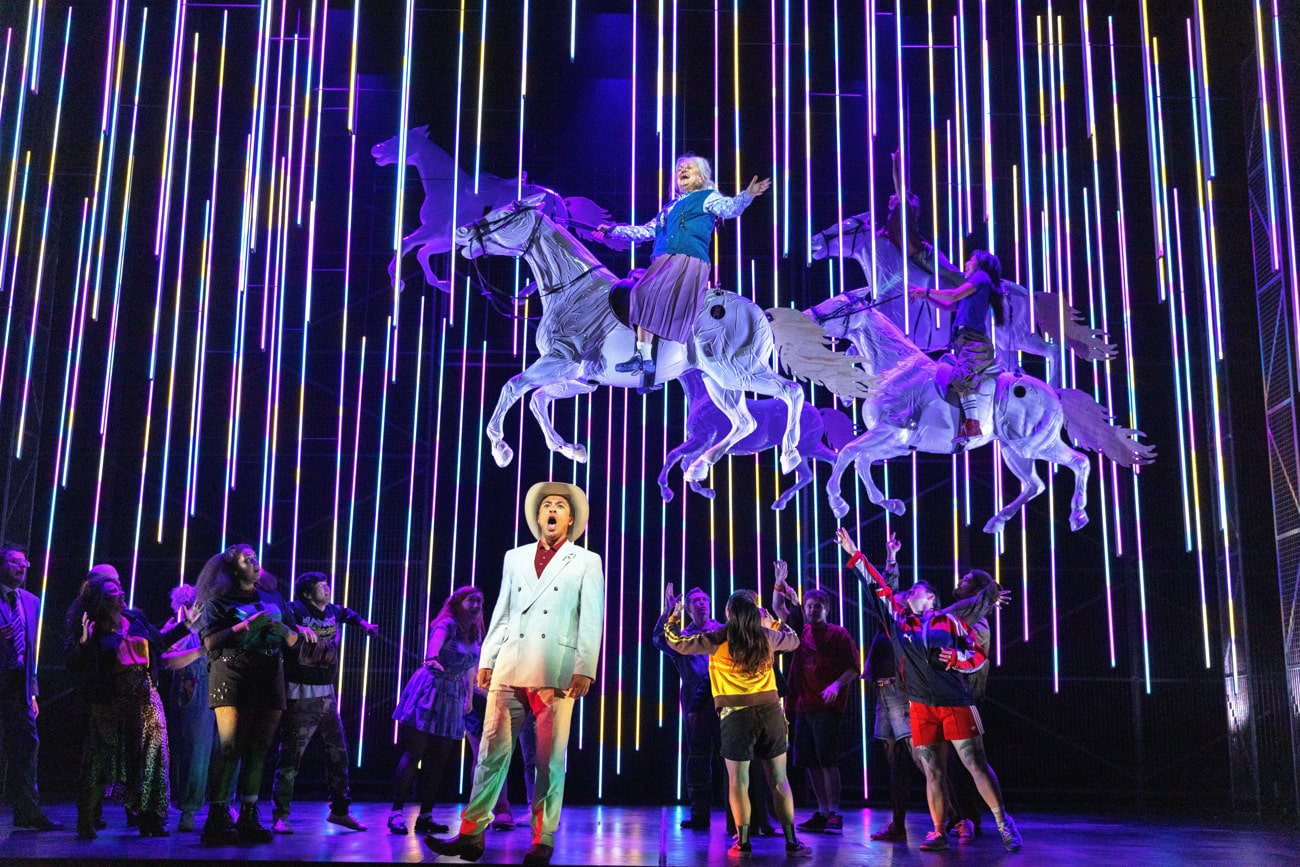
Mack approaches Theresa, who is holding her granddaughter Rosa in her arms. He insists that they are partners until the very end. Theresa resists, but she can’t undo the damage. Ivona and Noy are transformed into carousel horses, and the residents ride on.
Mack then confronts Theresa with Rosa, the baby, insisting that they are partners in the town’s destruction. Theresa resists but cannot undo the damage: Ivona and Noy are transformed into carousel horses, and the town continues to ride.
Theresa continues to do everything she can to help the people of the small town, now plagued by the darkness of addiction.
Theresa reaffirms her commitment to serving the town in the face of addiction.
Article by author Karen Russell
Author Karen Russell: “Pain is a deeply personal, untranslatable experience”
Karen Russell was commissioned by Missy Mazzoli and Royce Vavrek to write the original story on which *The Galloping Cure* is based, inspired by Franz Kafka’s short story “A Doctor in the Country.”
She begins her article with Emily Dickinson’s poem number 599, presented here in the original language—as well as a quote from the book *Empire of Pain: The Secret History of the Sackler Dynasty* by Patrick Radden Keefe, freely translated:
There is a pain—so utter—
It swallows substance up—
And covers the Abyss with Trance
So Memory can step
Around—across—upon it—
As one within a Swoon—
Goes safely—where an open eye—
Would drop Him—Bone by Bone—
“One of Roche’s competitors, Wallace Laboratories, was the first to bring to market a mild sedative called Miltown, which became a runaway success…”
The Galloping Cure was born From a conversation between Missy Mazzoli, Royce Vavrek, and me in the winter light of 2022. Missy and Royce had previously adapted one of my short stories into the opera *Proving Up*. This time, we came up with the plot together. I loved hanging out in a Zoom room with Missy and Royce, who are brilliant collaborators and close friends. In our early conversations, we talked about the opioid crisis and the greed within the global opioid industry, about grief and love, about opera’s ability to portray the dreamlike and nightmarish dimensions of addiction, about the magical horses in Franz Kafka’s surrealist masterpiece *A Doctor in the Country* and the “great wound” that afflicts both doctor and patient. A halting and unsteady thread of an idea began to take shape.
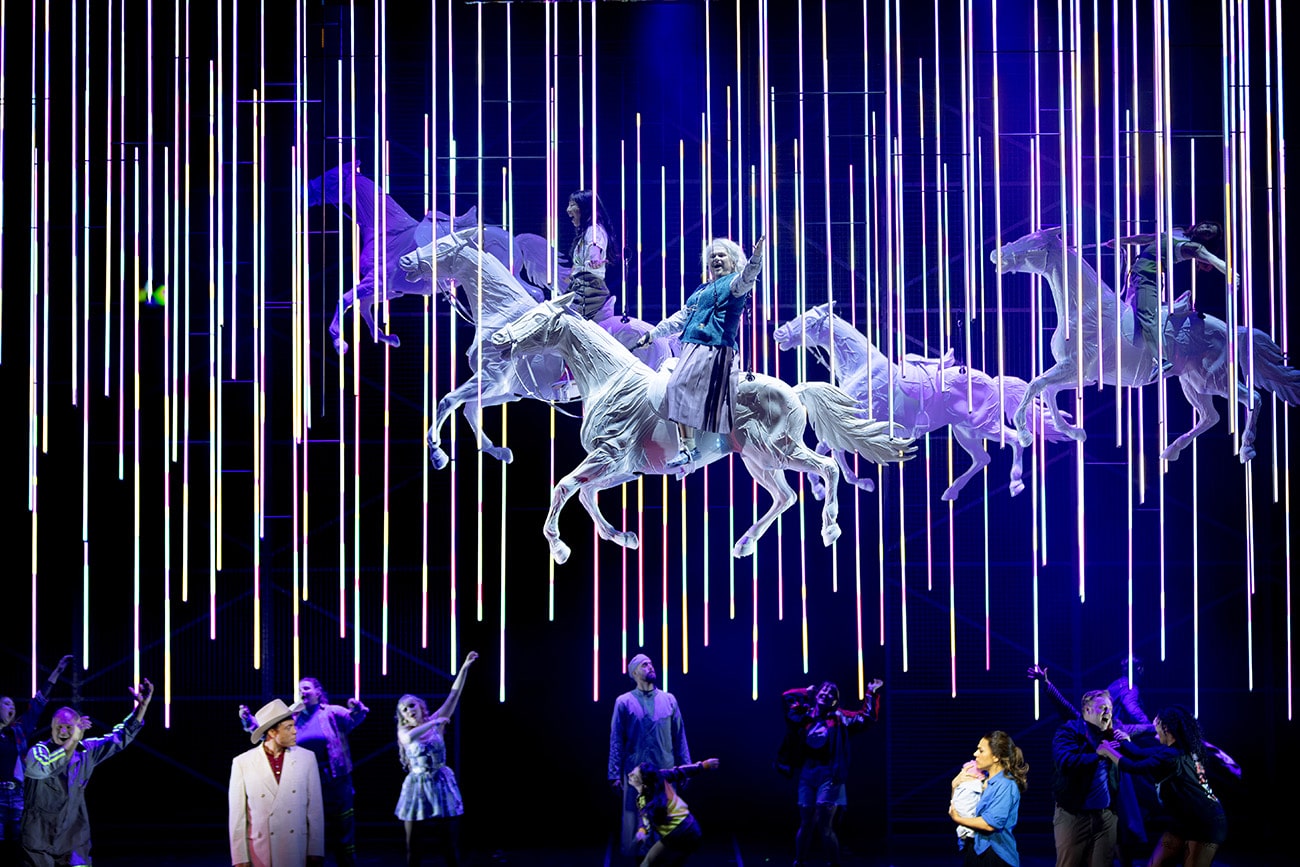
In my original scenario, a devil arrives in a dilapidated mining town and offers the residents complete relief from pain. He calls his miracle cure “the galloping cure.” A gleaming carousel appears in the town square. Grinning horses with eyes of sea glass await their riders. “Ride these,” he instructs the townspeople, “and you will be transported. My horses will carry you out of your suffering, out of time, and into a heaven within your own souls.” The townspeople rock faster and faster on their “enchanted steeds” and escape the monotonous tone of pain. The music inside their heads changes as they reach a world that is exactly as it should be: a symphony of light and color, ultraviolet flowers blooming on the bare, icy branches. What’s the catch? At first, there doesn’t seem to be one. But the bill arrives. Over time, “the galloping cure” turns into a curse.
This is the story of a dying town, ravaged by addiction. It is also the story of how a small-town doctor loses her way. Dr. Theresa Hart cares for the townspeople, whose needs seem bottomless. She loves her patients and does everything in her power to ease their suffering. She raises both her teenage daughter, Noy, and her granddaughter, Baby Rosa. Grief haunts their home and the town below. Dr. Hart finds comfort in rocking Baby Rosa to sleep. The lullaby evokes a comforting melody and a sense of wanting to surrender completely to a mother’s warm embrace—the same wonderful feeling of “warm, milky love” that the doctor’s patients experience as they rock on their demonic horses.
But it’s never as euphoric as the first time. Now they sway on the horses with a somber desperation. They can never hear that glorious song at the same frequency; the world no longer softens or glows with the same intensity. Instead, they sit strapped to the horses, their feet merging with the stirrups. Rocking round and round, growing ever thinner and sicker. They must ride, to keep all color from seeping out of the world. To keep their bodies from shaking apart. To escape the whinnying dread of dismounting. There is no way back to the daylight. To get out of these saddles, back to the earth. Everything is covered in snow—the trembling riders and the horses’ frozen smiles…
We came up with the title “The Galloping Cure” together. There’s something about the word “galloping”— —that reckless, heart-pounding pace is just right for this story about people trying to escape their pain but just running around in circles, driven by the fear of withdrawal, trapped on a hellish merry-go-round, with no way out in sight.
Pain is such a deeply personal, untranslatable experience. Its cruel paradox is that we feel our own pain completely, intimately, at its core—and yet we can only guess at what is going on inside another body, even that of a loved one: a brother, a sister, a lover, a child. From our own pain, we imagine someone else’s pain. Imagination is the only thing that can bridge the vast, snow-covered chasm that separates one consciousness from another. In *The Galloping Cure*, Dr. Hart crosses the bridge between her own life and her patients’ lives every day. She crosses the chasm, listens to her patients as they describe their symptoms, and does her best to move from diagnosis to a solution. Caring for others can, of course, be a very lonely task, especially when failure is the only thing one can expect.
As an allegory, I hope *The Galloping Cure* feels open to multiple interpretations. For us, this story isn’t just about the tragedy of opioid addiction, or the “cure” that has led so many to ruin. It is also a metaphorical exploration of the abyss—the bottomless void of existential suffering that Dickinson charts in her poem.
After I had written down my feverish dream scenario, Royce, Missy, and Tom Morris further developed the story. Only Royce could have come up with such a perfect name for our diabolical healer—“Lucky Mack”—or a refrain as terrifying as this: “their faces split open in a smile.” It has been an immense pleasure to bring this dream to life on paper together and watch it transform into a multidimensional opera.
Text: Karen Russell
Translated by Norrlandsoperan
Written for the world premiere at the Edinburgh International Festival and republished with the festival’s permission.
Karen Russell is a Pulitzer Prize finalist, a National Book Award finalist, and a recipient of the MacArthur and Guggenheim Fellowships. She has written three short story collections and two bestselling novels, one of which, *Swamplandia!*, has been translated into Swedish.
Author Karen Russell: “Pain is such a deeply private, untranslatable experience”
Karen Russell was commissioned by Missy Mazzoli and Royce Vavrek to write the original story on which *The Galloping Cure* is based, inspired by Franz Kafka’s short story “A Country Doctor.”
There is a pain—so utter—
It swallows substance up—
And covers the Abyss with Trance
So Memory can step
Around—across—upon it—
As one within a Swoon—
Goes safely—where an open eye—
Would drop Him—Bone by Bone—
Emily Dickinson, 599
‘One of Roche’s competitors, Wallace Laboratories, was first to market with a mild tranquilizer called Miltown, which became a runaway success…’
Patrick Radden Keefe, *Empire of Pain: The Secret History of the Sackler Dynasty*
The Galloping Cure It began as a conversation between Missy Mazzoli, Royce Vavrek, and me in the winter light of 2022. Missy and Royce had adapted one of my earlier short stories into an opera Proving Up. This time, we came up with the scenario together. I loved haunting a Zoom room with Missy and Royce, who are brilliant collaborators and dear friends. In our early exchanges, we talked about the opioid crisis and the greed of the global opioid industry; about grief and love; about opera’s power to convey the dreamlike and nightmarish dimensions of addiction; about the magical steeds in Franz Kafka’s surreal masterpiece “A Country Doctor” and the “great wound” that afflicts doctor and patient alike. A fledgling idea began to take shape.
In my original scenario, a devil arrives in a dilapidated mining town, offering complete freedom from pain. He calls his miracle treatment “the galloping cure.” A shining carousel appears in the town square. Grinning horses with sea-glass eyes await their riders. “Rock on these,” he instructs the townspeople, “and you will be transported. My horses will carry you out of agony, out of time, and into a sky inside you.” The townspeople rock faster and faster on their “enchanted steeds,” escaping the monotonous note of pain. The music inside their minds changes as they reach the world as they have always felt it should be: a symphony of light and colors, ultraviolet flowers opening on the skeletal, icy branches. What’s the catch? At first, it seems there is none. But the bill comes due. As time passes, the galloping cure becomes a curse.
This is the story of a dying town ravaged by addiction. It is also the story of how a rural doctor loses her way. Dr. Theresa Hart cares for the townspeople, whose needs seem bottomless. She loves her patients and does everything in her power to ease their suffering. She is raising both her teenage daughter, Noy, and her granddaughter, Baby Rosa. Grief haunts their home and the town below. Dr. Hart finds solace in rocking Baby Rosa to sleep. The cradle sings a lullaby, evoking the sensation of drifting into a mother’s warm embrace—the same sensation of absolute rightness and “warm, milky love” that the doctor’s patients experience while rocking on their demonic horses.
It is never as euphoric as the first time. Now, they rock back and forth on the horses with grim desperation. They are never able to hear the glorious singing at the same pitch; the world never softens and brightens with the same intensity. Instead, they are lashed to the horses, their feet melting into the stirrups. Round and round, growing gaunter and sicker. They must ride simply to keep all color from leaching out of the world. To keep their bodies from shaking apart. To halt the whinnying dread of dismounting. There is no way to safely return to daylight. To slip free from these saddles and come home to the earth. Snow covers everything—the shivering riders and the frozen smiles of their horses…
We decided on “The Galloping Cure” as the title together. There is something about the headlong, heart-racing momentum of “galloping” as a modifier for “cure” that felt right for this story, in which people attempt to escape their pain only to find themselves running in circles, lashed by the fear of withdrawal, trapped on a hellish, inescapable carousel.
Pain is such a deeply private, untranslatable experience. Its cruel paradox is that we know our own pain utterly, intimately, entirely—and yet we can only guess at what is happening inside another body, even the body of a loved one: a brother, a sister, a lover, a child. From our own pain, we imagine another’s pain; the imagination is the only bridge that spans the great snowy chasm separating one consciousness from another. In The Galloping Cure, Dr. Hart bridges the gap between her life and her patients’ lives every day, crossing the abyss. She listens as her patients describe their symptoms and does her best to move from diagnosis to a solution. Of course, caring for fellow human beings can be very lonely work, especially when failure is inevitable.
As an allegory, I hope that *The Galloping Cure* can be interpreted in many ways: for us, this story is not only about the tragedy of opioid addiction, or the “cure” that has led so many into oblivion. It’s also a metaphorical exploration of “the abyss,” the “bottomless” void of existential suffering that Dickinson depicts in her poem.
After I wrote my fever-dream of a scenario, the story was workshopped by Royce, Missy, and Tom Morris. Only Royce could come up with a name as perfect as “Lucky Mack” for this diabolical “healer,” or a line as terrifying as “their faces split open in a smile.” It has been an immense pleasure to bring a dream to life on paper together and witness its transformation into a multidimensional opera.
Written by Karen Russell
Written in advance of the world premiere at the Edinburgh International Festival, and republished with the festival’s permission.
Karen Russell is a Pulitzer Prize finalist, a National Book Award finalist, and a MacArthur and Guggenheim fellow. She is the author of two bestselling novels, *The Antidote* and *Swamplandia! *, and three short story collections: *Orange World and Other Stories*, *Vampires in the Lemon Grove *, and *St. Lucy’s Home for Girls Raised by Wolves*.
Missy Mazzoli
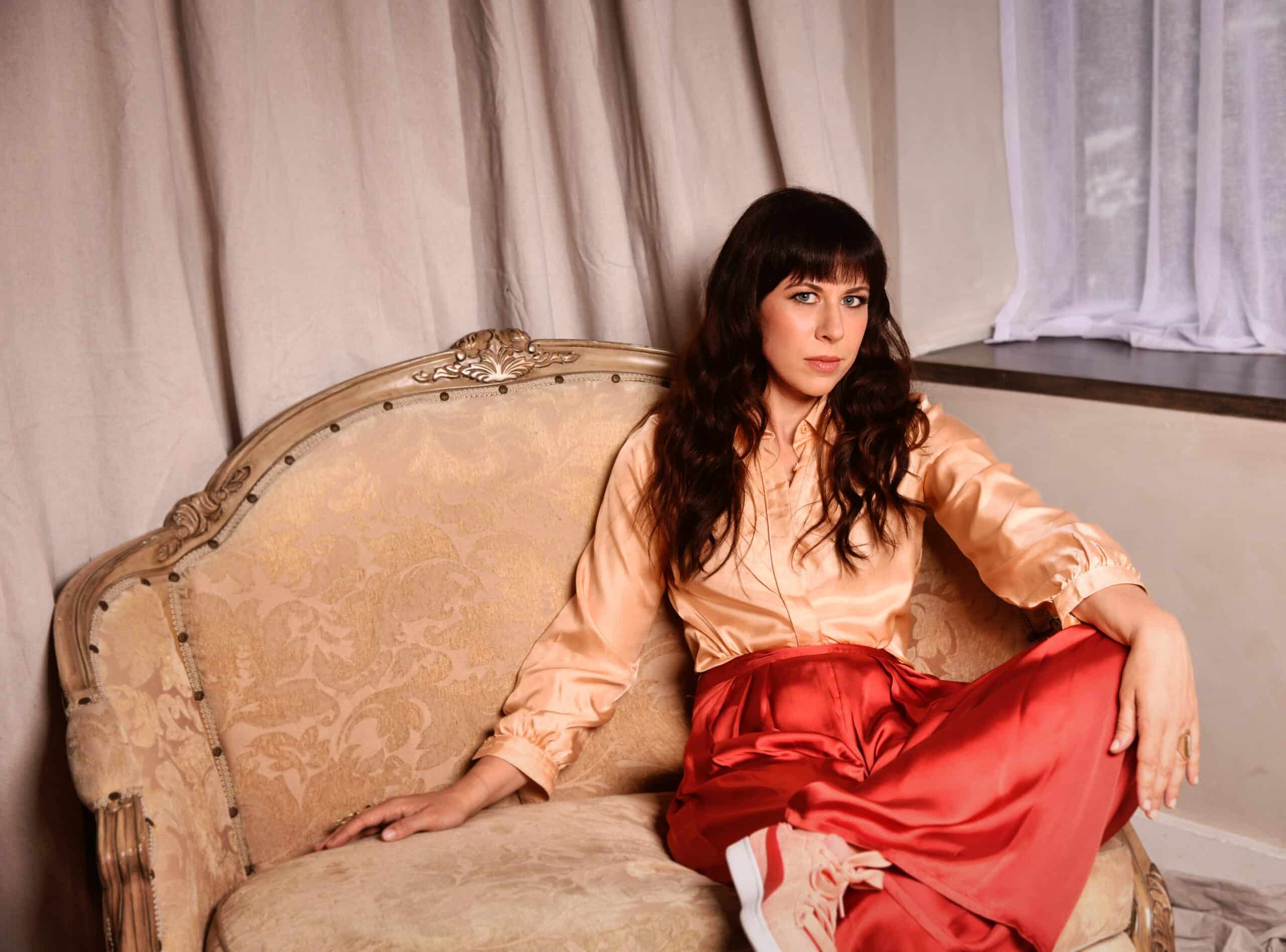
In *The Galloping Cure*, Missy Mazzoli has set the ecstasy and tragedy of addiction to music. Ahead of the premiere, we asked her to share her inspiration and hopes for the work. Perhaps the opera can spark conversations that otherwise would not have taken place.
1. Why does a story about addiction belong on the opera stage?
– There are very few people in the U.S., and fewer and fewer in the rest of the world, who are completely unaffected by opioid addiction. For me and my librettist, Royce Vavrek, this is certainly not an abstract topic. We have both lost family members and close friends to addiction; it’s something we’ve been living with for a long time. As artists, we’ve been talking for several years about how we could create a work about the opioid crisis. With this team and this opera, we’ve found a way to do it.
2. Where did the creative process begin?
– *The Galloping Cure* is based on an original story that we asked author Karen Russell to write for this opera. Together with Royce, I spent months discussing addiction and how we could portray it on stage. From there, textures and themes began to come to me. I understand the world through music. It’s my way of creating meaning, of giving a voice to situations and emotions for which we lack words.
3. The opera revolves around a mysterious carousel that relieves pain. Where did that image come from?
– The idea for the carousel came from Karen. It’s a fantastic metaphor for addiction—a striking visual image. There’s something entertaining about it, but also something a little grotesque. The idea of going nowhere—of literally going around in circles—is very powerful.
4. What does opera bring to a story like this?
– Opera is a place for grand ideas. It offers space for real tragedies, great love, redemption, hope, and the possibility of overcoming impossible obstacles. The story of addiction contains all of this, and opera can accommodate that complexity. You have music, libretto, movement, and set design, all of which tell different parts of the story. They can even contradict each other at times. A character might make a problematic decision, but the music can still lead us to feel compassion.
5. What would you like to say to anyone coming to see *The Galloping Cure*?
– Fasten your seatbelts—here we go. More than anything else, I hope this opera gives people a way to talk about difficult topics like addiction, family, and loss—and that those conversations continue long after the performance is over.
This interview was conducted ahead of the world premiere at the Edinburgh International Festival and republished with their permission.
In *The Galloping Cure*, Missy Mazzoli gives musical expression to the ecstasy and tragedy of addiction. Ahead of the premiere, we asked her where the piece began for her—and what she hopes it might bring to light. Perhaps the opera can spark conversations that otherwise wouldn’t take place.
1. Why did addiction feel like something that belonged on the opera stage?
“There are really very few people in America—and increasingly around the world—who have not been affected by opioid addiction. For me and my librettist Royce Vavrek, this isn’t an abstract concept. We’ve both lost people—family members, close friends—to addiction. It’s something we’ve been living with for a long time. As artists, we talked for years about how to create a work about this crisis, and with this team and this opera, we found a way.”
2. Where did the creative process begin?
“The Galloping Cure is based on an original story written specifically for the opera by the American writer Karen Russell. Together with Royce, we spent months discussing addiction and how we could bring it to life on stage. From there, textures and themes began to take shape in my mind. I understand the world through music—it’s my way of making sense of things, of providing a language for situations and emotions for which we don’t have words.”
3. The opera revolves around a mysterious carousel that relieves pain. Where did that image come from?
“The idea for the carousel really came from Karen, and it’s such an amazing metaphor for addiction—such a striking visual image. There’s something entertaining about it, but also a little bit grotesque. And the idea of going nowhere—literally going around in circles—is very powerful.”
4. What does opera bring to a story like this?
Opera is a place for big ideas. There’s room for great tragedy, great love, great redemption and hope, and the overcoming of impossible obstacles—that’s the story of addiction, and opera can encompass all that complexity. You have music, text, movement, and design, all telling different parts of the story, sometimes even contradicting one another. A character might make a troubling decision, but the music can still guide us toward compassion.
5. What would you say to someone coming to see *The Galloping Cure*?
Buckle up—it’s a wild ride. More than anything, I hope it gives people a way to talk about difficult topics—addiction, family, loss—and that those conversations continue long after the performance ends.
The interview was conducted ahead of the world premiere at the Edinburgh International Festival and is republished here with their permission.
The Music
Missy Mazzoli, a composer who has been nominated for multiple Grammy Awards, lives in New York. In the five-star review of In *The Galloping Cure*, *The Times* described her as “a composer at the top of her game”—a composer at the peak of her career. The world premiere of her next work is already scheduled for October, Lincoln in the Bar atThe Metropolitan Opera. This makes her the first woman to have a work commissioned specifically for The Met. Missy Mazzoli collaborates regularly with Royce Vavrek. Their opera “Breaking the Waves” had its Scandinavian premiere at the Vadstena Academy in 2022. Missy Mazzoli has visited the Norrlandsoperan before, performing with her band Victoire at the MADE Festival in 2012. She is also a certified end-of-life doula.
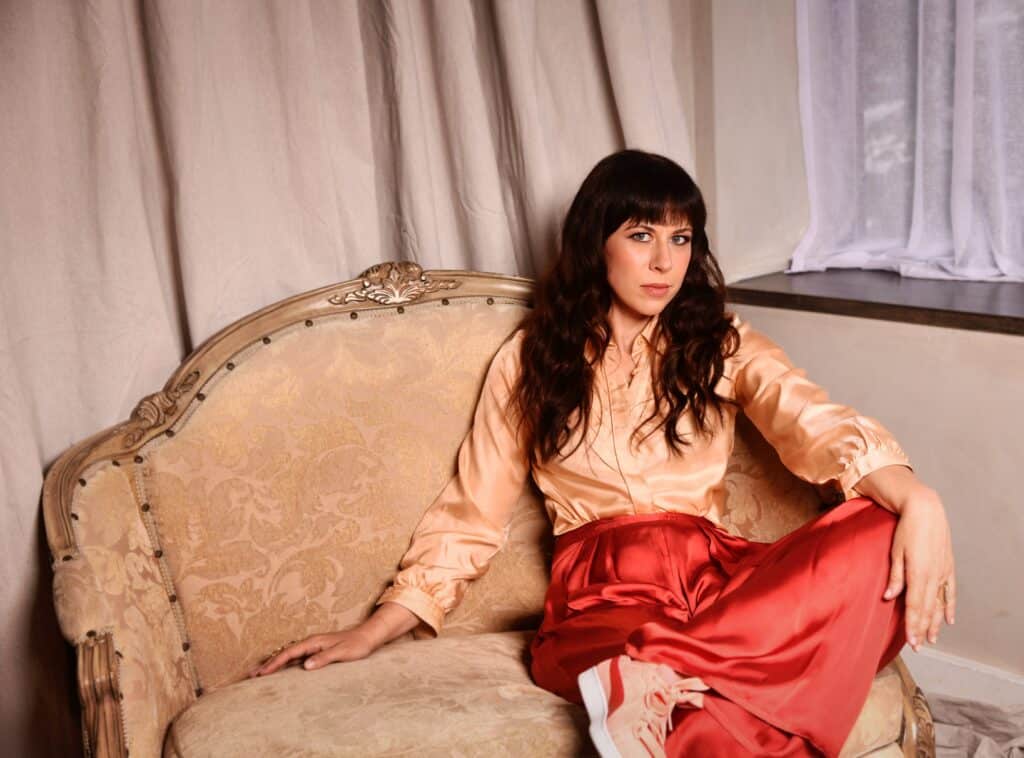
Librettist Royce Vavrek was born in Alberta, Canada, and lives in Brooklyn. His opera *Angel’s Bone*, written in collaboration with composer Du Yun, was awarded the 2017 Pulitzer Prize for Music. Vavrek is a frequent collaborator with Missy Mazzoli. Together, they have created the acclaimed operas Song from the Uproar, Breaking the Waves, Proving Up, “The Listeners ” and the upcoming “Lincoln in the Bardo ” for The Metropolitan Opera. Together with composer Mikael Karlsson, he has also created opera adaptations of two classic films: Melancholia 2023 and Fanny and Alexander 2024. Vavrek is the artistic director of the multi-award-winning experimental opera house Against the Grain Theatre in Toronto. In his free time, he enjoys photographing New York City’s street life.
Artistic Team
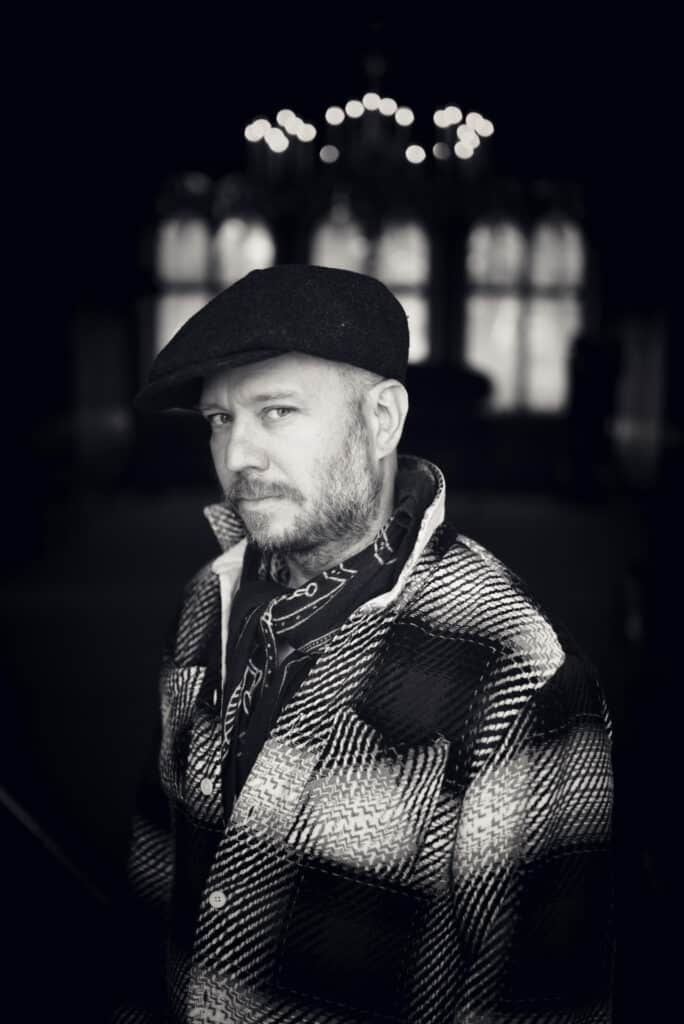
Australian-British conductor Jessica Cottis lives in Stockholm and is the artistic partner of the Västerås Sinfonietta. She is now returning to the Norrlandsoperan after conducting John Adams’ opera *The Death of Klinghoffer* there in 2023. Cottis is the artistic director and principal conductor of the Canberra Symphony Orchestra, where she has made a name for herself through collaborations with Indigenous artists and by showcasing female composers. She regularly guest-conducts at the world’s leading venues, including the London Symphony Orchestra, the Los Angeles Philharmonic, and the Royal Opera House, and has previously conducted Missy Mazzoli’s *Breaking the Waves* for Opera Australia. Outside of music, Cottis is a devoted butterfly enthusiast.
Learn more about Jessica Cottis
Award-winning British director, writer, and producer Tom Morris previously directed Missy Mazzoli and Royce Vavrek’s opera *Breaking the Waves*, which premiered at the Edinburgh International Festival and subsequently toured to Paris, Detroit, and Houston. His other opera productions include *Orfeo* (Vienna State Opera) and *The Death of Klinghoffer* (English National Opera / Metropolitan Opera, New York). For *War Horse* At the National Theatre in London, which he co-directed with Marianne Elliott, Morris was awarded a Tony Award for Best Direction. The play became a global success and has since been performed in 14 countries and 97 cities for over eight million audience members. Other works at the National Theatre, in the West End, and at the Bristol Old Vic—where he served as artistic director from 2009 to 2022—include *Touching the Void*, *Dr. Semmelweis*, *Othello*, *EGBDF*, and *A Midsummer Night’s Dream*. Tom was an associate director at the National Theatre from 2004 to 2024, serves as chairman of Complicite, and has been awarded an OBE for his contributions to the theater.
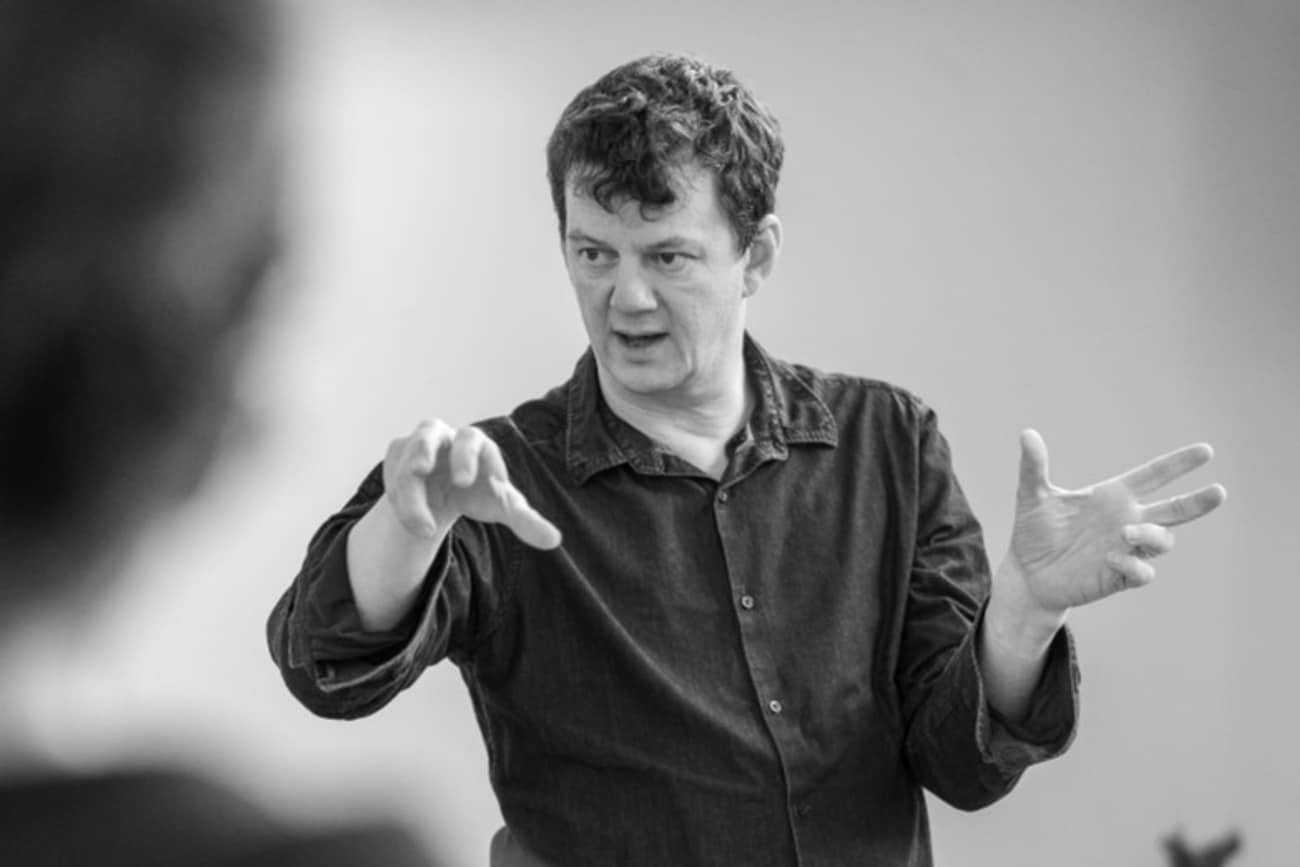
Leah Hausman lives in London and works internationally as a choreographer, movement director, and assistant director. She trained in dance and drama in New York and at the École Jacques Lecoq in Paris, and has collaborated with Terry Gilliam, Sir David McVicar, and Simon McBurney, among others. Hausman has participated in productions at some of the world’s leading opera houses, including the Royal Opera House, The Metropolitan Opera, the Glyndebourne Festival, and the San Francisco Opera. She is a regular workshop leader at the Festival d’Aix-en-Provence and has led workshops at London’s leading opera and theater institutions.
Christina Cunningham is a costume designer working in theater, opera, and dance, with a long-standing collaboration with the theater company Complicité. She has designed costumes for several of the world’s leading opera houses, including the Royal Opera House (The Rise and Fall of the City of Mahagonny, The Importance of Being Earnest), the Aix-en-Provence Festival (Wozzeck, The Rake’s Progress), Scottish Opera (*Carmen*), and the Royal Danish Opera (*The Handmaid’s Tale*). In theater, she has worked with the National Theatre and the Bridge Theatre in London, among others.
Learn more about Christina CunninghamOver the past twenty years, British lighting artist and lighting designer Lucy Carter has designed lighting for theater, ballet, dance, and musicals. She has collaborated with the San Francisco Ballet, the New York City Ballet, the Bolshoi Ballet, and the Paris Opera Ballet, among others. She has a long-standing collaboration with choreographer Wayne McGregor and has designed the lighting for his productions Woolf Works, Autobiography and Raven Girl. In the world of opera, she has worked with, among others, Hansel and Gretel (San Francisco Opera), Salome (English National Opera) and La finta giardiniera (Glyndebourne, Teatro alla Scala, Shanghai). Carter has won the prestigious Knight of Illumination Award for dance twice, for Chroma (2008) and Woolf Works (2015).
Learn more about Lucy CarterWilliam Duke is a video and projection designer working internationally in opera, theater, dance, musicals, and experimental performing arts, and his work has been presented in the United Kingdom and internationally. Among other projects, he has designed projections for *Parsifal* (Semperoper Dresden), *Wozzeck* (Aix-en-Provence Festival), *Das Rheingold* and *Die Walküre* (Deutsche Oper Berlin), *Orlando* (Vienna State Opera), and *Breaking the Waves* (Houston Grand Opera, Detroit Opera, Opéra Comique Paris, Scottish Opera). In theater, he has worked with the Royal Shakespeare Company, Complicité, and the Young Vic, among others. In 2016, Duke was awarded the Knight of Illumination Award for Best Projection Design for his work on *The Encounter*.
Learn more about Will DukeEnsemble
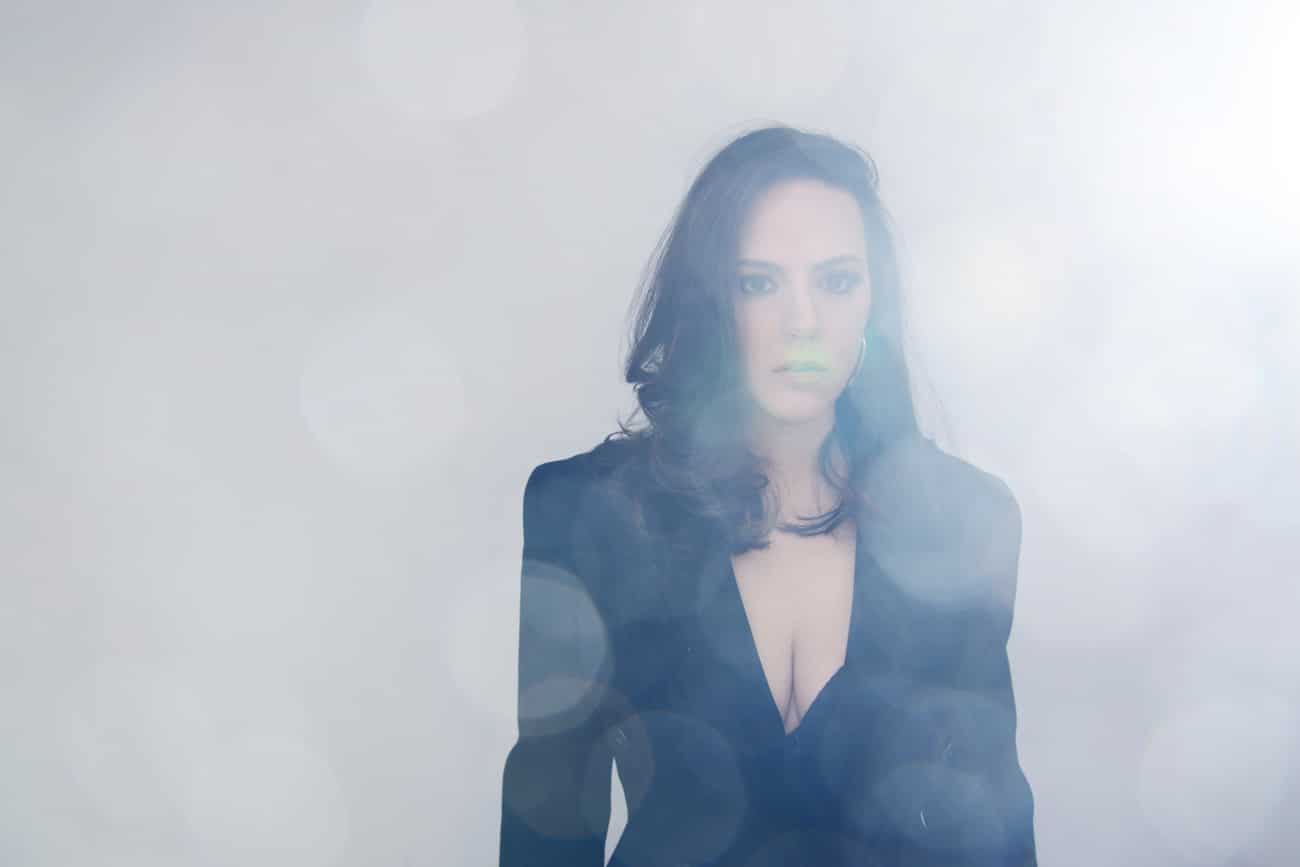
The American-Argentine mezzo-soprano Daniela Mack was born in Buenos Aires, grew up in Texas, and now lives in the San Francisco Bay Area. She is described as a passionate, adventurous, and naturally charismatic performer, and her voice has been described by Opera News as “polished onyx: strong, deep, and lustrous.” Mack has portrayed, among others, the artist Frida Kahlo and the poet Federico García Lorca on the opera stage, and appeared in Mazzoli and Vavrek’s opera *The Listeners*. Regarding her portrayal of Theresa Hart in *The Galloping Cure*, *The Guardian* wrote that her mezzo-soprano voice is “an iron fist in a velvet glove—perfect for the conflicted doctor.”
Baritone Justin Austin was born into an opera family. His career began as a boy soprano in New York, where he grew up and studied at the Manhattan School of Music. He was named “Rising Star of the Year” at the 2024 International Opera Awards and received the Marian Anderson Vocal Award that same year. He has been praised by The New York Times for his rich, lyrical voice and by the Washington Post as “a star just waiting for a universe to form around him.” Regarding his portrayal of Lucky Mack, the Edinburgh Music Review wrote that his voice is as velvety smooth as the character he plays.
Learn more about Justin Austin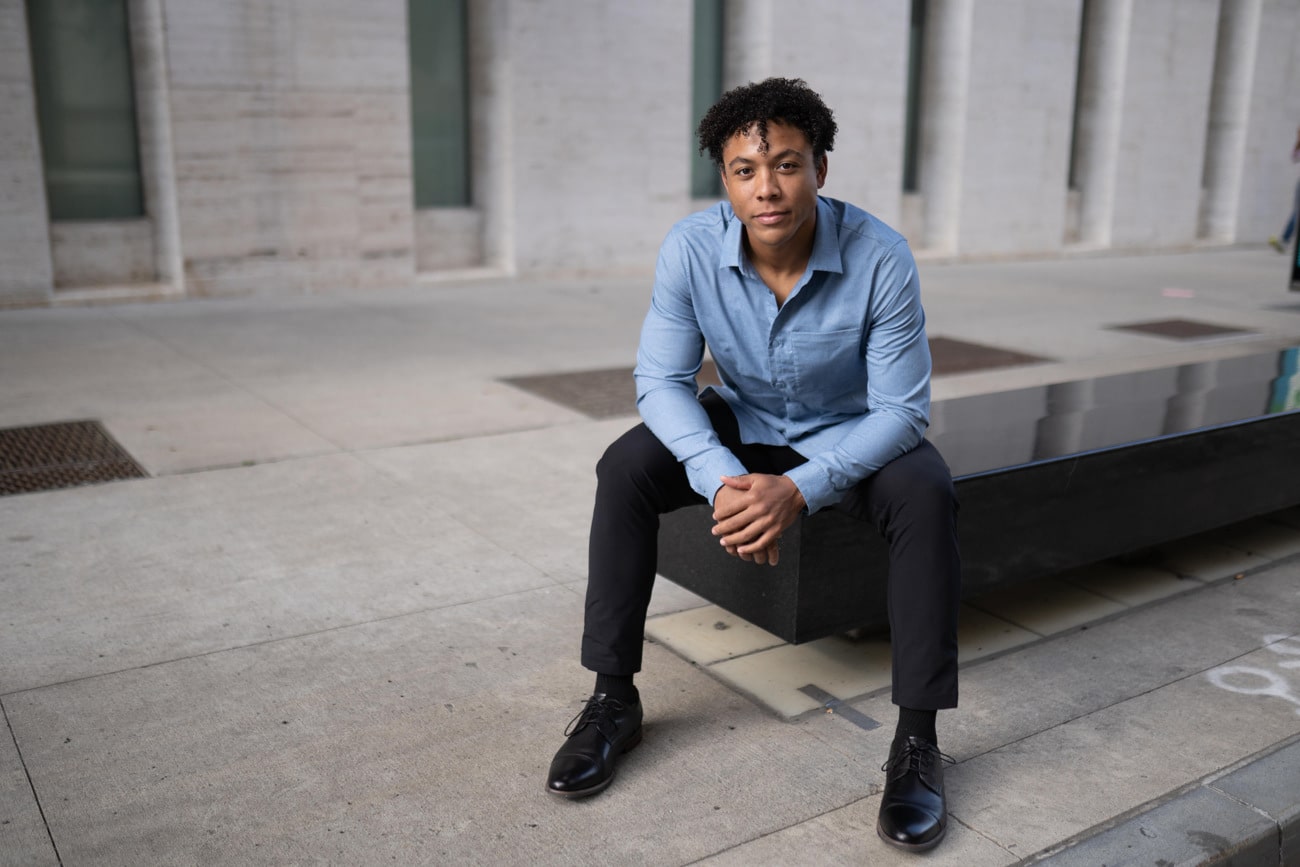
British soprano Susan Bullock is considered one of the leading dramatic sopranos of her generation and made history as the first to sing four consecutive *Ring* cycles at the Royal Opera House in London. Her interpretations of Brünnhilde and Elektra have taken her to stages around the world, including The Metropolitan Opera. Regarding her role in *The Galloping Cure*, *The Scotsman* wrote that she “dominates the stage with her majestic Ivona.” Bullock has performed at the Last Night of the BBC Proms and sang at the closing ceremony of the 2012 London Olympics.
Learn more about Susan Bullock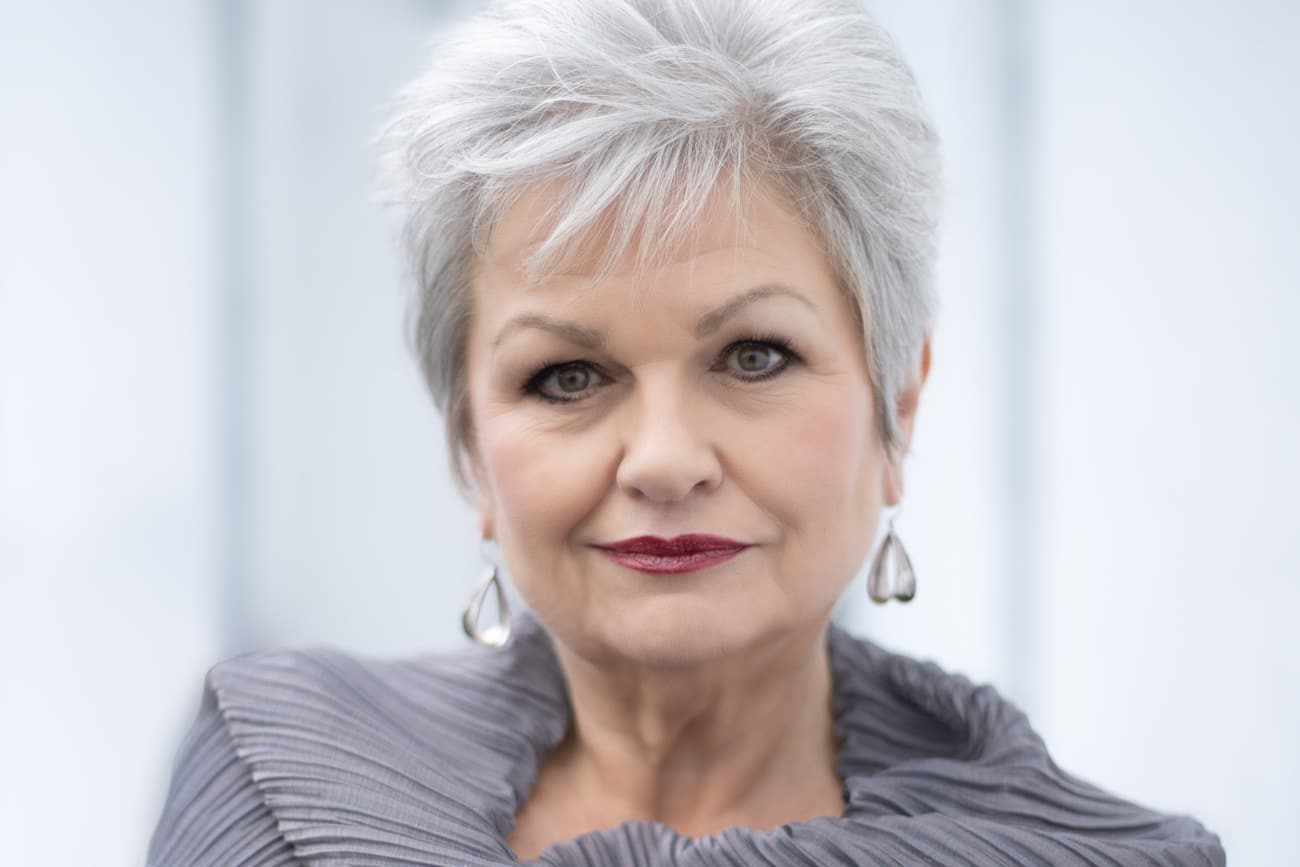
Swedish-Norwegian soprano Sandra Bendrik graduated from the Opera School at the Stockholm University of the Arts in 2024 and has been a member of the Norwegian Opera through WOYS since the 2024–25 season —the Wilhelmsen Opera Studio for Young Singers—where she has sung roles such as Annina in *La traviata*, Stasi in *Die Csárdásfürstin*, and Fiordiligi in *Così fan tutte*. She also holds a degree in Professional Dance and Musical Theater from The Urdang Academy in London and has been awarded several scholarships, including one from the Swedish Wagner Society and the Anders Sandrew Vocal Scholarship.
Learn more about Sandra Bendrik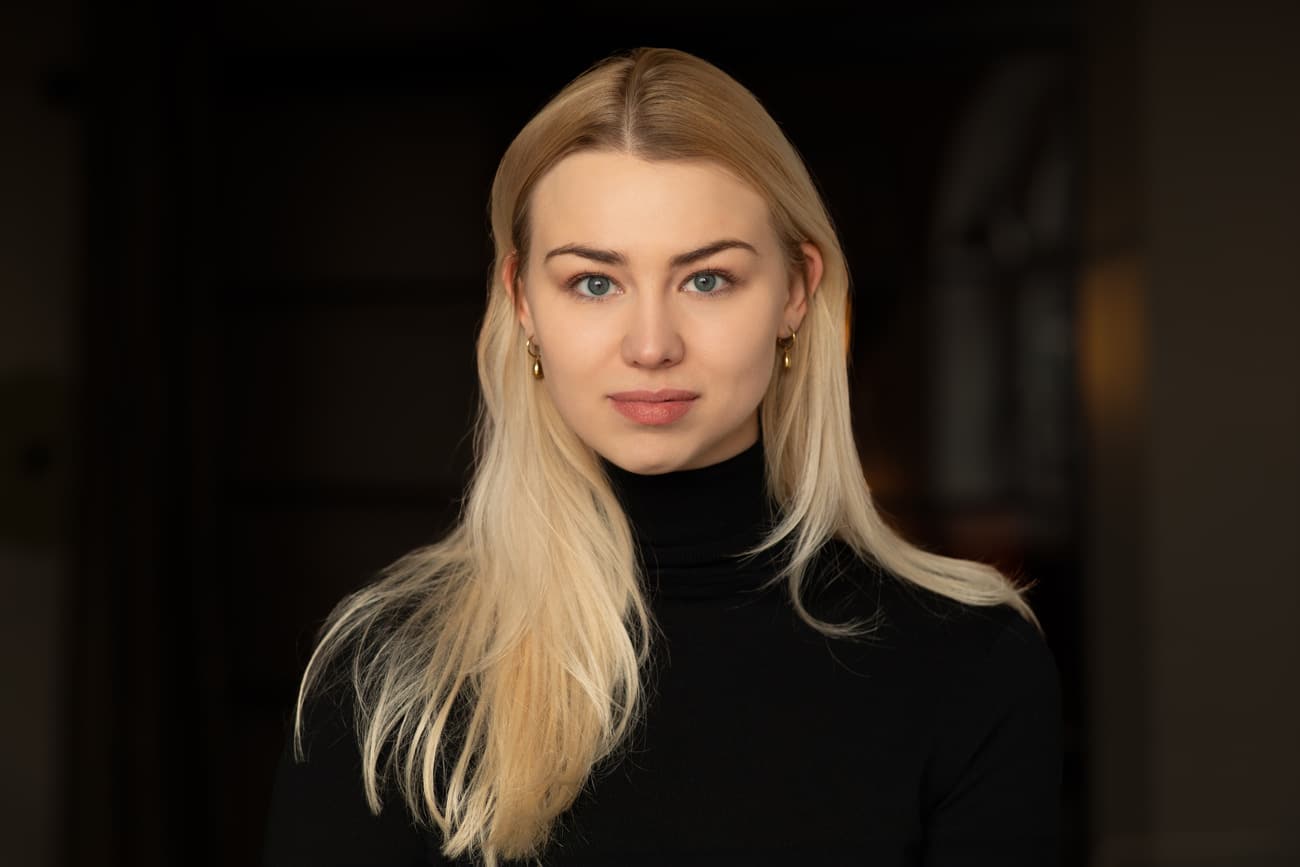
Edinburgh-born soprano Catriona Hewitson was named one of Opera Now’s Hot List Young Artists for 2022 and won the 2018 Kathleen Ferrier Loveday Song Prize. She has been a Scottish Opera Emerging Artist and appeared in their five-star productions of *A Midsummer Night’s Dream* and *The Makropulos Affair*. In late 2025, she made her debut with English National Opera in the title role of Handel’s *Partenope*. *The Galloping Cure* marks Hewitson’s Scandinavian debut, and she will return to Scottish Opera during the 2026–27 season. She trained at the Royal Northern College of Music and the Royal College of Music Opera Studio.
Learn more about Catriona HewitsonBass-baritone Edward Jowle grew up in Derbyshire and is a graduate student at the Royal College of Music. In 2019–20, he was part of the Samling Institute’s mentorship program and has received support from the Drake Calleja Trust and the Josephine Baker Trust, among others. His most recent opera roles include Guglielmo in *Così fan tutte*, Papageno in *Die Zauberflöte *, and Falke in *Die Fledermaus*. He has performed in concert works such as Handel’s *Messiah* and Mozart’s *Requiem*, and has participated in masterclasses with Gerald Finley and Thomas Quasthoff.
Learn more about Edward JowleSoprano Alva Olsson made her acclaimed professional debut as Pamina in *The Magic Flute* at Vattnäs Konsertlada in 2022, at just 22 years old. She was the youngest of the eight finalists in the 2024 Stenhammar International Music Competition and has participated in the Bergen National Opera’s Young Artist Academy, as well as sung the role of Papagena in *The Magic Flute* at the Gothenburg Opera during the 2025–26 season. Olsson trained at the Stockholm University of the Arts, Opera Studio Kapellsberg in Härnösand, and the Lyric Opera Studio in Weimar. She has been awarded several scholarships, including from the Jubelårsfonden and the Anders Walls Foundation, and is also active as an oratorio and church singer.
Learn more about Alva OlssonMezzo-soprano Amie Foon has previously performed with the Norrlands Opera, including as Omar in John Adams’ *The Death of Klinghoffer* and Nicklausse in *Les Contes d’Hoffmann*. In 2023, she was awarded the Drottningholm Opera Friends’ Opera Scholarship by His Majesty the King for her “warm mezzo voice and strong stage presence.” Foon has also performed at Grange Park Opera and Opera Holland Park, with a repertoire ranging from Monteverdi and Mozart to Bizet and Britten. She trained at the Guildhall School of Music and Drama in London and the Stockholm Opera Academy, where she now resides.
Tenor Fredrik Hagerberg trained at the Malmö Academy of Music and graduated from the Malmö Opera Academy in 2024. In February 2025, he made his opera debut at Malmö Opera in Strauss’s *Salome*. He has sung the role of Don Ramiro in *Cinderella* both at Malmö Opera in the fall of 2025 and at Norrlandsoperan earlier this year. Hagerberg has previously sung Tamino in *The Magic Flute* with both Suitcase Opera and Strömstad Opera, and has participated in several world premieres of contemporary operas, including Jonatan Sersam’s *Tinget* and Josef Zetterberg Phil’s *Vita bron*. He has been awarded several scholarships, including the Lasse Löhndahl Vocal Scholarship and the Grand Order of Amaranth Cultural Scholarship.
Mezzo-soprano Linnea Andreassen is from Uppsala and now lives in Stockholm. She made her opera debut in 2015 at the Royal Swedish Opera in Der Rosenkavalier and last year she played Brigitte in Jenny Wilson’s opera The Mistresses at the Norrlands Opera in 2025. At the Malmö Opera, she has appeared in, among other productions, The Crown Bride 2023 and Cinderella 2025, and has extensive experience with contemporary music, including several world premieres, among them Folkoperan’s The Gospel of Åle 2022. That same year, she portrayed Andronico in Vivaldi’s Il Giustino at the Drottningholm Palace Theater. In 2018, she became the first recipient of the Friends’ Opera Scholarship from the Friends of the Drottningholm Palace Theater, presented by His Majesty the King. Linnea Andreassen studied at the Royal College of Music and the Stockholm Opera Academy.
Learn more about Linnea AndreassenTenor Jihan Shin graduated from Yonsei University in South Korea and continued his studies in Italy at the Licinio Refice Conservatory and the Accademia Teatro alla Scala. He won first prize in the Giacomo Lauri-Volpi and Rolando Nicolosi competitions and has also placed in several other international competitions. He made his debut at Teatro alla Scala as Conte Alberto in *L’occasione fa il ladro*. He has sung leading roles at Italy’s Teatro Regio di Parma, Teatro Filarmonico di Verona, and Teatro Verdi di Firenze. In Sweden, he made his debut at the Royal Swedish Opera as Lysander in *A Midsummer Night’s Dream*, and has also performed at the Ulriksdal and Drottningholm Palace Theaters, the Norrlands Opera, and with the Aalborg Philharmonic Orchestra.
Bass Staffan Liljas earned his master’s degree in opera from the Stockholm Opera Academy in 2012. Earlier this year, he sang the role of Don Magnifico in Rossini’s *Cinderella* at the Norrlandsoperan. He has a long-standing collaboration with Cappella Mediterranea and Leonardo García Alarcón and has, among other roles, sung the part of Polyphemus in Handel’s *Acis & Galatea* at several European venues. Liljas’s repertoire ranges from Verdi and Puccini to newly composed music. He has premiered five operas and two oratorios, including roles in *Melancholia* at the Royal Swedish Opera and *Animals That Hate People* at the Uppsala City Theater. He is also an active concert soloist and has performed works by Bach and Handel with several Swedish and European orchestras. In 2022, he released the solo album *Baroque Bass*, and he serves as chairman of the Early Music Society.
Baritone Viktor Rydén from Stockholm has been praised for his warm, clear tone and natural stage presence. He studied at the Royal College of Music and the Stockholm Opera Studio and earned his master’s degree from the University of Music and Performing Arts Vienna in 2022. Rydén made his international debut in 2023 as Schemariah in the world premiere of Bernhard Lang’s opera *Job* in Klagenfurt, and has since performed at venues including the Hamburg State Opera under Kent Nagano, the Skåne Opera, and the Drottningholm Palace Theater. He is also a frequently engaged concert singer with a broad repertoire, ranging from Baroque to contemporary music, as well as an experienced lieder singer specializing in Schubert, Schumann, and Mahler.
Soprano Lydia Kjellberg studied at the Stockholm University of the Arts. In the summer of 2023, she made her major breakthrough as Lady Macbeth in Läckö Opera’s production of *Macbeth*, and in the summer of 2022, she was acclaimed as the Queen of the Night in *Die Zauberflöte* at Vattnäs Konsertlada. Kjellberg participated in the world premiere of the opera *Sylvia* with the Piteå Chamber Opera and, in the summer of 2025, sang the role of Violetta in *La Traviata* at the Sunne Summer Opera. She is also an active concert soloist and has, among other things, performed at an acclaimed concert at Villa Wahnfried in Bayreuth, where she was invited after being awarded the Swedish Wagner Society’s Bayreuth Scholarship in 2022.
Learn more about Lydia KjellbergTenor Carl Fischer is 26 years old and lives in Stockholm. He trained at the Stockholm Opera Studio, the Vadstena Academy of Voice and Piano, and the Stockholm Academy of Opera. Fischer has been awarded several scholarships, including the Otto Lindblad Scholarship, the Teaterorden TSO Scholarship, the Hans Björklund Scholarship, and the Confidence Scholarship.
Ella Vahtras, a mezzo-soprano, was born and raised in Linköping. She has studied at institutions including the Kapellsberg Opera Studio in Härnösand and the Royal College of Music in Stockholm. She is currently studying at the Norrlandsoperan Opera Studio (ONO) and is also appearing as a chorus member in this spring’s production of *Tosca* at the Norrlandsoperan. Ella is a freelance musician who has performed as both a soloist and a chorus member in several masses and oratorios. In the spring of 2025, she appeared as the Evangelist in the St. Luke Passion by Martinsson/Greider. In 2025, she earned her master’s degree from the Piteå School of Music, where she studied under Katherine Osborne.
Movement artists
Faith Prendergast is a dancer and actress of Anglo-American descent, currently living in Margate, United Kingdom. She grew up in Colorado, USA, and continued her training at the San Francisco Conservatory of Dance under the guidance of Summer Lee Rhatigan, as well as at the Rambert School of Ballet and Contemporary Dance, where she earned a bachelor’s degree with highest honors. Since then, she has worked as a freelancer in dance, theater, and opera in the United Kingdom and internationally, collaborating with directors and choreographers such as Oona Doherty, Laurent Pelly, Simon McBurney, and Leah Hausman. Prendergast also co-founded Margate Movement Artists, a group of dancers in Margate dedicated to promoting dance in the region.
Karl Fagerlund Brekke was born and raised in Copenhagen, in a theatrical environment where his father runs the Commedia School of Physical Theater. At the age of 18, he gave up ice hockey and began his dance training at Sceneingangen in Copenhagen, before continuing his studies at the London Studio Centre and the Rambert School. He has supplemented his training with studies under Geoffrey Colman, Gabrielle Moleta, and Guillaume Pigé, among others. Since graduating, he has worked with choreographers and companies such as Arthur Pita, Léa Tirabasso, Complicité (Simon McBurney), Ballet Ireland, Junk Ensemble, Russell Maliphant, Annabel Arden, Luca Silvestrini’s Protein, Lucy McCormick, Leila McMillan Dance, and Alexander Baczynski-Jenkins. At the British National Dance Awards, he was nominated for Outstanding Male Performance (Modern) for his role in Arthur Pita’s Stepmother/Stepfather.
Danuta Ramos has performed around the world as a circus artist and dancer since 2005 and is one of Scotland’s leading acrobats and aerialists. She has received widespread acclaim for her work as a soloist and in collaboration with Suspended Motion, with support from Creative Scotland and Dance Base, among others. Ramos has a strong background as an aerial artist, acrobat, dancer, and physical theater artist, and has worked with ensembles such as Batman Live, Emergency Exit Arts, Iron Oxide, and Wired Aerial Theatre.
Learn more about Danuta RamosSaya Yamaguchi is an aerialist, hair-hanger, and acrobat based in Edinburgh. She is a regular performer and teacher with the companies All or Nothing Aerial Dance Theatre, Skylarks Entertainment, and Oraya Circus Duo, and has created works for a variety of projects and events in collaboration with, among others, Upswing, Mimbre, Delighters, and Paper Doll Militia. Saya has toured throughout Scotland, England, Europe, and North America. She loves both challenging and yielding to gravity—flying, dancing in the air and on people, draping herself, dangling, and tangling herself in exciting ways.
The Norrlands Opera Symphony Orchestra
Violin I
Kanerva Mannermaa, Miguel Chamorro, Lucy Baker, Kitiara Braune, Per-Erik Andersson, Amandus Lind, Isaac Bachs Viñuela, Mikhail Zatin
Violin II
Pontus Björk, Clara Bjerhag, Kersti Wilhelmsson, Matias Malmqvist, EvaBritt Molander, Lars Warnstad
Viola
Ester Forsberg, Pablo Muñoz Salido, Doris Mägi, Johanne Skaansar, Åsa Hjelm
Cello
Simon Sundström, Ilario Fantone, Bekhbat Tsagaanchuluun, Karin Bjurman, Kristina Tereschatov, Kerstin Isaksson
Double bass
Jan-Emil Kuisma, Charlotte Petersson, Josefin Landmér
Flute
Ebba Wallén, Michaela Hansen
Oboe
Johannes Ögren, Emmanuel Rolland-Bezem
Clarinet
Tania Villasuso Couceiro, Jonas Olsson Hakelind
Bassoon
Peter Bolton, Maria Kindell
Horn
Orvar Johansson, Yerang Ko, Edna Fernandes, Anders Kjellberg
Trumpet
Malin Silbo-Ohlsson, Anna Lindberg
Trombone
Peter Nygren, Matilda Gerhardsson
Bass Trombone
Mathias Petersson
Tuba
Linus Mattsson
Percussion
Maximiliano Polo, Ian Piniés, Per Mikaelsson
Harpa
Ivanna Fridh
Learn more about the Norrlandsoperan Symphony Orchestra here: norrlandsoperan.se/norrlandsoperans-symfoniorkester

Production Team
Artistic Director, Opera: Dan Turdén
Production Manager: Britta Amft
Orchestra Director: Anna Sjödin
Technical Director: Håkan Brohlin
Producer: Esther Von Schoenberg
Assistant Director: Susanna Levonen
Rehearsal Director I: Jonas Olsson
Rehearsal Director II: Darya Tchaikovsky
Associate Producer: Robert Dahl Norsten
Orchestra Producer: Gene Kindell
Stage Manager: Tarja Ylinen
Assistant Stage Manager: Mia Berglund
Prompter: Ludvig Nitzler
Stage Managers: Stefan Sjödin Sandgren (Production Manager), Kieron Johnson (Scottish Opera), Pernilla Rehn
Lighting Master: Johan Jerrskog (Production Manager), Jessika Flodell
Lighting Console Operator: Per Dunder
Follow-spot Operators: Jessika Flodell, Nick Bohman
Stage Technicians: Kristoffer Norgren, Laura de Jong, Sebastian Larsson, Samuel Björö, Mikael Farstad
Assistant Stage Technicians: Joakim Widell, Julia Christoffersson
Orchestra technician: Jerry Ericsson
Sound Technician: Anders Nyberg
Props Managers: Linnea Öhrlund (Production Manager), Catharina Carlsson, Anders Muammar
Makeup Artists: Amelia Cazorla Lozano (Production Manager), Charlotta Hjalmarsson, Metha Engqvist Griffiths
Assistant Makeup Artist: Mats Sperens
Costume Technicians: Anna Eliasson (Production Manager), Rachel Jackson (Scottish Opera), Kitty Grenholm, Fanny Sallinen
Costume Designers: Jenny Stade, Miranda Lundin, Clara Silverlöv
Set Designer: Maja Johansson
Workshop: Peter Lundmark, Fredrik Larsson
The Galloping Cure
Opera by Missy Mazzoli
Program
Photo: Malin Arnesson, Christopher Bowen and Norrlandsoperan’s communications and marketing department
Texts by Norrlandsoperan’s Communications and Marketing Department
The work was commissioned by Opera Ventures Productions, Scottish Opera, and Norrlandsoperan with support from the Riksbankens Jubileumsfond, “RJ Art and Culture,” the Edinburgh International Festival, and San Francisco Opera.
The opera is a co-production of Opera Ventures Productions, Scottish Opera, Norrlandsoperan, the Canadian Opera Company, San Francisco Opera, and State Opera South Australia.
Pursuant to
Norrlandsoperan is 60% owned by Region Västerbotten and 40% by the City of Umeå. We receive grants from the Swedish Arts Council.
Many thanks to all our donors and partners.