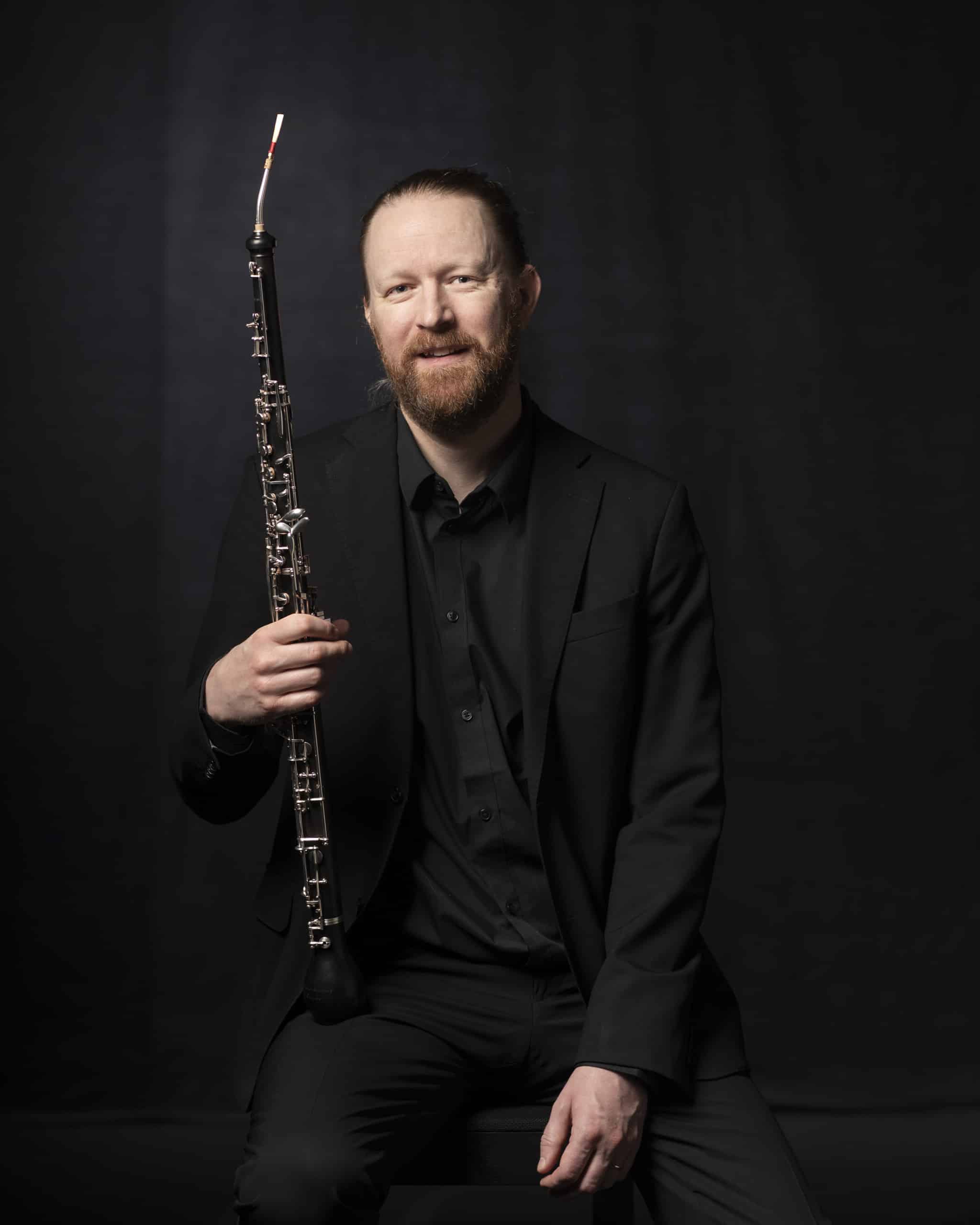
“Just like elite athletes, we need to stay in top shape so we can play our best every time.”
Oboe: Johannes Ögren
Meet the Musicians
My mom told me that when I was little, I heard an oboe on TV and said, “I want to play THAT.” Even though I don’t remember this myself, maybe that’s where it all started with music.
But I wanted to become a tennis coach, too—which I did, despite some resistance from my parents. I worked as a coach for a few years back home in Örnsköldsvik before I went on to the Academy of Music in Gothenburg. By the way, I was also discouraged from becoming a musician—but I think both my mom and dad are proud of me now.
I see it as if I’ve earned my position in the orchestra. I’m very proud of that. The process was a long one—I auditioned in 2010 and, after many weeks of auditions and a trial year, was notified in September 2012 that I’d gotten the job. For someone like me, opportunities like this are rare, so once I landed the job, we took the chance and moved. The whole family is really happy here.
From 2012 to 2016, I was also a section leader, which means having primary responsibility for the section and the artistic responsibility of playing the first part. Now I’m an alternate section leader in charge of the English horn, which for me is a great mix that lets me play just about everything.
Sometimes I train both physically and mentally specifically for certain concerts. This line of work involves high-level performance, and there’s always the expectation that I’ll be in top form when it counts. I’d say we prepare just like elite athletes, where the concert itself is the thrill that also reveals how we’re performing that day—just like in a game or competition.
One concert I remember very well was Brahms’s violin concerto with Henning Kraggerud as soloist and Johannes Gustafsson conducting. I had just started my probationary period here and was incredibly nervous, especially about the solo in the slow movement. On top of that, the hall was packed to the brim—there were even people standing along the railings above the orchestra in the balcony. Just as I started playing the solo, I suddenly had a strong feeling: “I want to go home right now; this doesn’t feel right at all.” What do you do? It’s not the time to just get up and leave, of course. A quick internal scolding, a mental “pull yourself together,” and then I just had to keep playing. The whole internal crisis took place in a fraction of a second; no one in the orchestra or the audience noticed a thing.
Even Beethoven’s Ninth with Rumon Gamba in 2013… it was absolutely dreadful! The second movement has a festive oboe solo that isn’t all that difficult, but it goes on for quite a while. I was thorough and played through that section every morning for a few months, which I was very grateful for when it was finally time for the concert: I start playing the solo, then all sound around me disappears and the world appears as if through a pair of upside-down binoculars. Total tunnel vision—I remember thinking I wanted to go home to Mom! But—my fingers had played that section so many times that they just kept going whether I was paying attention or not. No one noticed anything strange!
My practice strategy is based on listening rather than playing a lot. I tune in and form a picture of what role I’ll play in the context. If we’re going to play one of the portal works, you probably already know it well—that’s part of the deal. And if you’ve “done the work beforehand,” you can also relax during the concert.
Otherwise, the variety is what this job is all about. I love the mix! Some of my personal musical favorites include Mahler—for example, I love the beautiful, somber *Kindertotenlieder*, which feature a lot of oboe and English horn—as well as Mozart and Puccini. There’s a lot going on musically here, and the score might look simple at first glance, but—there’s a lot of tension and tension between the lines, and you can’t relax. I think it’s fantastic music. The charm of opera in particular is that it’s so alive, with us in the orchestra serving as the driving force.
Another recent favorite concert was the one we did with Annika Norlin. It was a fantastic concert with great songs, awesome arrangements, and the wonderful Annika! I’d love to do something similar with other artists—why not Lars Winnerbäck?
During the pandemic, I’ve actually gotten a little tired of being an oboist. But otherwise, when the mix is good and you’re in good shape, it’s fantastic to get to make music at work! It’s my dream job, even though—just like with any other job—it can be tough and boring at times.
It might be interesting to know that we oboists make the reeds we play with ourselves. Just as a skier’s wax is unique—and absolutely crucial—so too are the reeds. They’re made from a type of reed that grows like bamboo sticks and is sold by the kilo. Various machines are needed for the manufacturing process, and the tubes must be precise to within hundredths of a millimeter to be perfect. For me, 0.56–0.57 mm, for example, is perfect—0.55 is too thin, and 0.58 is just a little too thick. The climate in the hall is also important when you’re using them. Wood is, after all, a living material, and if the air is dry—as it is here in the north—it’s more difficult. I’ve had a tube simply stop working right in the middle of a performance.
I make a whole bunch of pipes at once. We have a wide variety of machines and tools—milling machines, planers, profiling cutters, edge planers, and knives—to produce the best possible pipes. Musician or woodworker—sometimes you wonder. Either way, it’s a craft that revolves around the material.
My oboe is “custom-made” by a Bulgarian who lives in Sweden from time to time. He also made the English horn I play. My oboe was “finished” in 2012—but it still took another two years before we were completely satisfied. Now it’s perfect for me. And that’s the advantage of choosing, buying, and owning your own instrument—it’s exactly the way I need it to be.
Personal
In my free time, I play tennis and squash and try to stay in shape as best I can. I read a lot, and music is another interest of mine. I almost always have music playing at home—either something we’re going to play at work or an album I’m currently obsessed with.