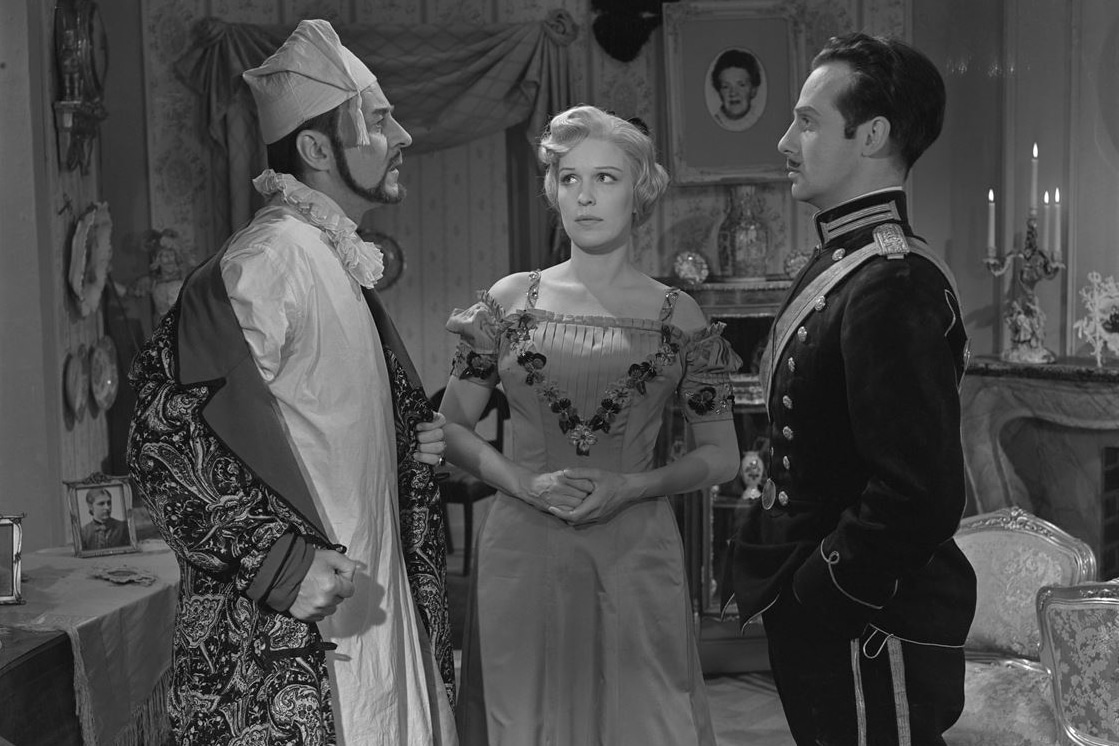
– Bergman is Sweden’s most underrated humorist!
Jan Holmberg is a film scholar and CEO of the Ingmar Bergman Foundation. He believes it’s high time to dispel the image of Bergman as merely a gloomy brooder.
“*Smiles of a Summer Night* is one of Sweden’s funniest movies ever. It’s easy to forget that when people talk about Bergman,” he says.
“Bergman is much more ironic toward men. They are all portrayed as pathetic in some way.”
The story is set around the turn of the 20th century, in a world of elegant salons, strict social conventions, and well-kept secrets. Bergman would later return to this same era in *Fanny and Alexander*.
“It’s a period close to Bergman’s heart—a few years or a decade or so before he was born. In French, it’s known as La Belle Époque, the ‘beautiful era,’ a comparatively bright period in European history before World War I,” explains Jan Holmberg.
Behind the respectable facade, forbidden feelings, jealousy, and desire are simmering. Everyone longs for love, but few seem to know what to do with it. And while the men get tangled up in their own vanity, it is the women who seem to have the best grasp of the situation.
“Bergman is much more ironic toward the men. They’re all portrayed as pathetic in some way—the stuffy lawyer, the macho soldier, and the fragile seminary student. They’re almost caricatures.”

The Women See Through the Game
*Smiles of a Summer Night* can be seen as a story of female emancipation. Although the plot takes place at a time when men still held formal power, it is the women who demonstrate the greatest self-awareness and drive.
Ingmar Bergman himself had a complicated relationship with love and fidelity, to say the least. By the time the film was shot, he had already been through three marriages.
“He seems to have had an ability to view even himself from the outside and see the comical aspects of what it means to be a man,” says Jan Holmberg.
“He seems to have had the ability to view even himself from the outside”
Comparisons to a light-hearted comedy
When the film premiered in 1955, Sweden had begun to move toward a more liberal view of sexuality and marriage. But not everyone appreciated that Ingmar Bergman had turned infidelity, depression, children born out of wedlock, and forbidden desire into a comedy. One critic likened the film to pilsner poured into champagne bottles—simple slapstick disguised as high culture. Olof Lagercrantz concluded his review with the words:
“I’m ashamed to have seen it.”
At the same time, *Smiles of a Summer Night* marked Bergman’s major international breakthrough. Its success at the 1956 Cannes Film Festival paved the way for *The Seventh Seal* and the long line of classics that followed.
More than 70 years later, the comedy has lost surprisingly little of its power, according to Jan Holmberg.
“I hardly think it’s aged at all! The first time I saw it, I was maybe 20 years old and had this image of Bergman as a gloomy guy. I was completely blown away by how funny it was. And the last time I saw it, I felt the same way,” he says.
TEXT: Olov Antonsson